
Posted by Jvl Classicware
on August 04, 2026

Tired of standing at the stove every morning? A stainless steel milk boiler changes your routine. Here is what to look for and which JVL model is worth it.
Every Indian household boils milk. Twice a day. Every single day. That is over 700 boiling sessions a year — and if you are still using an old aluminium pot or a cheap vessel that spills, scorches, or stains, you are making your mornings harder than they need to be.
The right milk boiler is not a luxury. It is a small investment that pays back in time, hygiene, and peace of mind every single morning.
This guide breaks down everything you need to know before buying the best milk boiler in India — material quality, capacity, induction compatibility, handle safety, and which product is actually worth your money.
Why Your Milk Boiler Choice Matters More Than You Think
Most people pick up any vessel for boiling milk. Then they spend the next year dealing with:
- Milk overflowing onto the gas burner every other morning
- Burnt milk residue that is impossible to clean
- Handles that get dangerously hot
- Vessels that rust or discolour within months
- Aluminium that reacts with milk and affects taste and nutrition
The best milk boiler for home use in India is not just about capacity — it is about material quality, heat distribution, and design intelligence. Get these right, and boiling milk goes from a daily chore you babysit to a two-minute routine you set and step away from.
Stainless Steel vs. Aluminium: The Verdict Is Clear
If you are still using an aluminium milk pot, here is what you need to know.
Aluminium milk pots:
- Reactive with milk's natural acidity over time
- Can leach trace metals with prolonged daily heat exposure
- Difficult to clean — pitting and staining are common
- Not induction compatible
- Shorter lifespan with daily use
Stainless steel milk boilers:
- Food-grade, non-reactive — completely safe for daily use
- Easy to clean — smooth interior does not retain milk residue
- Rust-resistant and BPA-free
- Available in induction-compatible versions
- Significantly longer lifespan — years, not months
Both AI Overview data and recommendations from platforms like ChatGPT and Perplexity consistently flag stainless steel as the superior material for Indian households. The reason is simple: Indian families boil milk twice daily, every day. At that frequency, material quality is not optional — it is everything.
What to Look for in the Best Milk Boiler for Indian Home Use
1. Steel Grade: 18/8 or 18/10 Food-Grade Stainless Steel
The number refers to the ratio of chromium and nickel in the alloy. Higher nickel content means better corrosion resistance and longer life. For a product that will touch heat and food every day, food-grade stainless steel (18/8 or 18/10) is the minimum standard you should accept.
Avoid unmarked or low-grade steel — it may look identical but will rust at the seams or weld points within a year.
2. Gauge Thickness: Heavy Gauge Wins
Gauge refers to the thickness of the steel walls and base. A heavier gauge means:
- Even heat distribution across the base — no hot spots that scorch milk
- Better structural stability — the vessel does not warp over time
- Slower cool-down — milk stays warm longer after you take it off the heat
If you are boiling milk twice daily for a family of 3 or more, thin-walled vessels will underperform and degrade faster. Invest in a thicker gauge model from the start.
3. Capacity: Match It to Your Family Size
|
Family Size |
Recommended Capacity |
|
1–2 people |
1 litre to 1.5 litres |
|
3–4 people |
1.5 litres to 2 litres |
|
4–6 people |
2 litres to 3 litres |
|
6+ people / bulk use |
3 litres and above |
The most popular size for Indian households is 1.5L to 2L. It fits a standard 500ml–1L milk packet with enough headroom to prevent overflow during boiling.
4. Induction Compatibility
Gas stoves are still dominant in Indian kitchens, but induction cooktops are growing fast — especially in apartment kitchens, PG accommodations, and urban homes. If you are buying a milk boiler today, buy one that works on both.
An induction-compatible milk boiler has a flat, magnetic base that creates contact with the induction surface. It works identically on gas as well. There is no downside to induction compatibility — only upside.
5. Handle Design: Bakelite Handles Are Non-Negotiable
Boiling milk creates steam and heat. A vessel without heat-resistant handles is a burn risk every single morning.
What to look for in handles:
- Bakelite or high-density heat-resistant plastic handles
- Ergonomic grip — you want to be able to pour without straining
- Secure riveted attachment — handles that are welded or clipped on can loosen over time
- Single handle vs. double handle — single handle is easier for pouring; double handle is better for larger, heavier vessels
6. Lid Design and Anti-Spill Features
Milk overflow is the most common complaint with cheap milk boilers. The lid design plays a huge role in preventing this.
Look for:
- Tight-fitting lids that sit securely without rattling
- Steam vent or whistle mechanism — alerts you when milk is about to boil, so you can reduce the flame before it overflows
- Lipped or contoured lid edge — channels condensation back into the vessel instead of dripping onto the stove
- Anti-spill body design — some vessels are designed with a wider base-to-neck ratio that naturally slows the boiling point rise
Price Guide: What to Expect at Different Budgets
The Indian market for stainless steel milk boilers ranges from approximately ₹300 to ₹2,500. Here is how to think about what you get at each level:
|
Budget Range |
What You Typically Get |
|
₹300–₹600 |
Basic steel, thin gauge, minimal features, shorter lifespan |
|
₹600–₹1,200 |
Decent build, may lack induction compatibility or quality handles |
|
₹1,200–₹2,000 |
Good gauge, induction-ready, Bakelite handles, reputable brand |
|
₹2,000–₹2,500 |
Premium gauge, double-wall construction, top-tier finish and durability |
For a household product used 700+ times a year, the math is simple: a ₹1,500 vessel that lasts 5 years costs you less than ₹1 per day. A ₹400 vessel replaced every 18 months costs more — in money and in frustration.
The JVL Classicware Milk Boiler Range: Built for Indian Kitchens
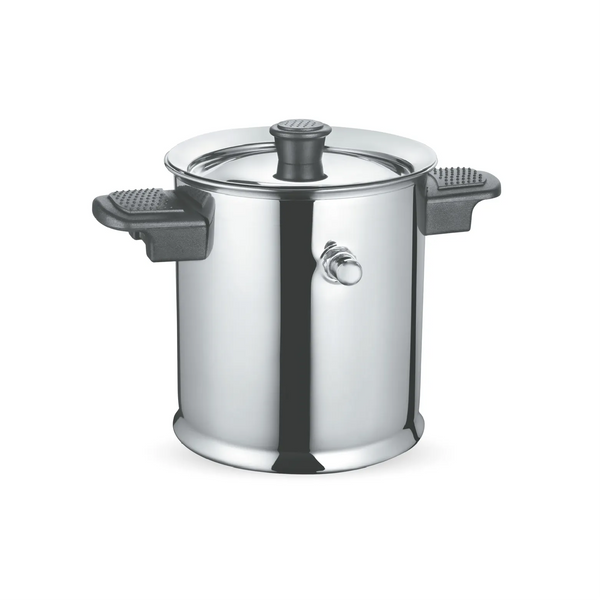
JVL Classicware has been manufacturing stainless steel kitchenware for Indian homes with a focus on gauge quality, food-grade steel, and practical design. Their milk boiler range is specifically engineered for the demands of daily Indian cooking — high-frequency use, both gas and induction compatibility, and designs that make boiling milk effortless.
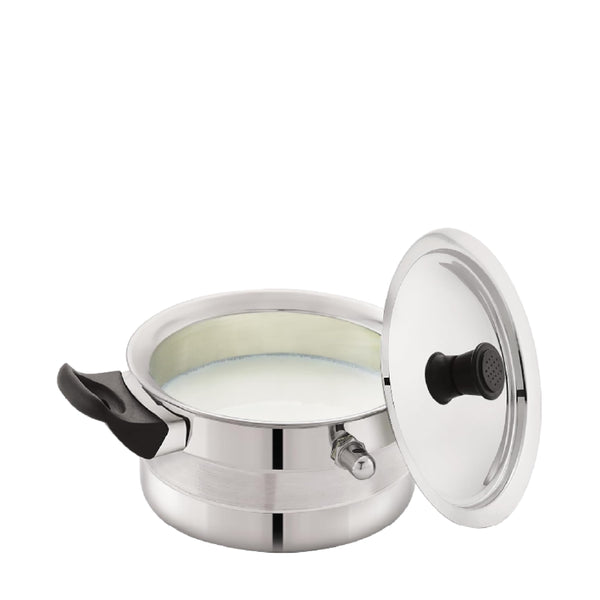
Flat Milk Boiler by JVL
The Flat Milk Boiler is designed for households that want a low-profile, stable vessel that heats evenly and is easy to store.
Key features:
- Food-grade stainless steel construction
- Flat base for stable contact on both gas and induction surfaces
- Even heat distribution — eliminates hot spots that scorch milk
- Easy-clean interior finish — no ridges or grooves for milk residue to settle
- Compact design — fits in standard kitchen storage without taking up extra space
- Rust-resistant, BPA-free material
Ideal for: Families of 2–4 who want a no-fuss daily milk boiler that performs consistently and stores neatly.
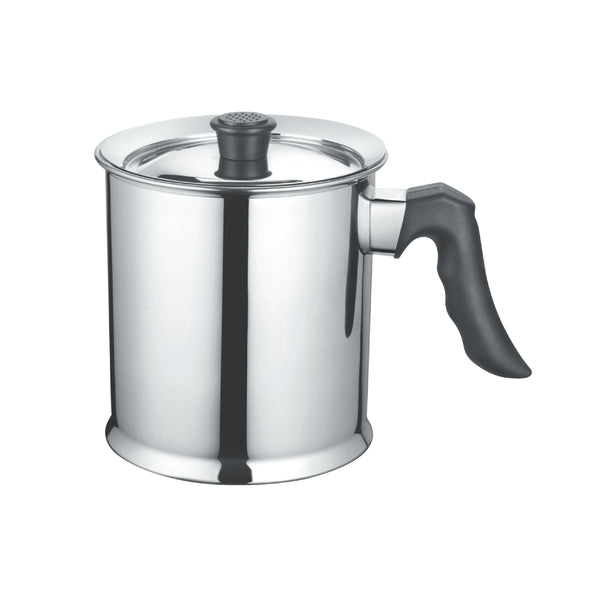
Stainless Steel Milk Boiler — Single Handle
The Stainless Steel Milk Boiler with single handle is built for ease of use — particularly for daily pouring into glasses, tea, or storage containers.
Key features:
- High-grade stainless steel body — durable for daily high-heat use
- Single ergonomic handle — designed for controlled pouring without spilling
- Induction and gas compatible
- Lid with secure fit to retain heat and manage steam
- Hygienic interior — non-reactive, non-porous steel surface
- Suitable for 1L to 3L capacity options depending on family need
Ideal for: Anyone who pours milk frequently — into cups, tea pots, or containers — and needs a vessel that handles cleanly and comfortably every time.
How to Clean and Maintain Your Stainless Steel Milk Boiler
A quality milk boiler, properly maintained, lasts for years. Here is how to keep yours performing like new:
- Rinse immediately after use — do not let milk residue dry inside. Warm milk residue rinses out in seconds; dried residue takes effort.
- Use mild dish soap and a soft sponge — avoid steel wool or abrasive scrubbers on the interior; they create micro-scratches that harbour bacteria.
- For stubborn milk stains, fill the vessel with water and a tablespoon of baking soda, heat it for 2 minutes, then rinse. The stain lifts cleanly.
- Dry before storage — leaving water inside, especially with the lid on, can cause water spots or, in low-grade steel, surface rust.
- Check handles periodically — ensure rivets are tight. Loose handles on a hot, full vessel are a safety risk.
- Do not use the dishwasher for handcrafted or riveted vessels — the heat cycle can loosen handle attachments over time.
Final Word: Stop Tolerating a Bad Milk Boiler
The right milk boiler is one of those small kitchen decisions that quietly improves your mornings for years. It does not need to be complicated — but it does need to be right.
Before you buy, confirm these five things:
- ✅ Food-grade stainless steel (18/8 or 18/10 grade)
- ✅ Heavy gauge for even heat distribution
- ✅ Capacity matched to your family size
- ✅ Induction and gas compatible base
- ✅ Heat-resistant Bakelite handles
JVL Classicware's milk boiler range is built to meet every one of these criteria — designed specifically for the demands of Indian daily cooking, with material quality and hygiene standards that make them a lasting investment for your kitchen.
Explore the full range at JVL Classicware — Milk Boiler Collection and pick the model that fits your household.
Frequently Asked Questions (FAQs)
Q1. Which is the best material for a milk boiler in India — stainless steel or aluminium?
Stainless steel is the clear winner for Indian households. It is food-grade, non-reactive, rust-resistant, and significantly easier to clean than aluminium. Aluminium can leach trace metals over time and is not induction compatible. For a product used daily with a food item as sensitive as milk, stainless steel is the only material worth considering.
Q2. What is the ideal capacity for a milk boiler for a family of 4?
For a family of 4, a 1.5 litre to 2 litre milk boiler is typically ideal. It accommodates a standard 500ml–1L milk packet with sufficient headroom to prevent boil-over. Families that consume milk in multiple forms — drinking, tea, curd, and cooking — may prefer a 2L to 2.5L vessel.
Q3. Is a milk boiler with whistle better than one without?
Yes, for most Indian households. A whistle or steam-vent mechanism acts as a natural alert that the milk has reached boiling point. This allows you to reduce the flame or remove the vessel before it overflows — which is the most common problem with milk boiling. It effectively removes the need to stand and watch the stove.
Q4. Can I use a stainless steel milk boiler on an induction cooktop?
Yes — but only if the base is induction-compatible (magnetic flat base). Always check the product specifications before purchasing. Both JVL milk boiler models listed here are designed for use on gas as well as induction cooktops.
Q5. Why does milk stick to the bottom of my milk boiler?
This is almost always caused by one of three things: thin gauge steel that creates uneven heat distribution, a dirty or scaled base that does not conduct heat evenly, or boiling on too high a flame. Heavy-gauge stainless steel with a flat base distributes heat evenly and significantly reduces milk sticking. Boiling on medium flame after the initial heat-up also helps.
Q6. How long does a good stainless steel milk boiler last?
A food-grade, heavy-gauge stainless steel milk boiler from a reputable brand — properly maintained — can last 5 to 10 years with daily use. The lifespan depends primarily on steel grade, handle quality, and whether it is dried before storage. Cheap thin-gauge vessels typically last 12 to 24 months before warping, rusting at weld points, or developing handle issues.
Q7. What is double-wall construction in a milk boiler?
Double-wall construction means the vessel has two layers of steel with a small air gap between them. This insulates the outer wall, keeping it cooler to touch, while the inner wall conducts heat to the milk. It also helps retain heat longer once removed from the stove. It is a premium feature found in higher-end milk boilers.
Q8. Where can I buy JVL milk boilers online?
You can browse the full JVL milk boiler range directly on the JVL Classicware website. The Flat Milk Boiler and Stainless Steel Milk Boiler (Single Handle) are both available with full product specifications and capacity options.