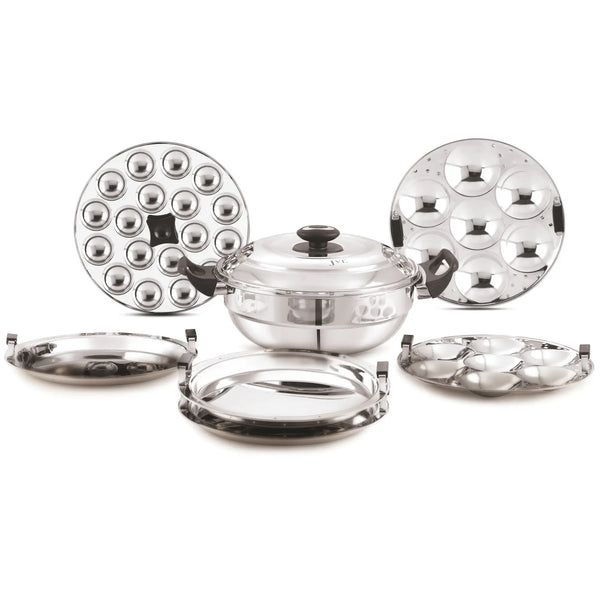

Posted by Jvl Classicware
on May 29, 2026

There is a quiet revolution happening in Indian kitchens, and it has nothing to do with a new masala or a trending recipe. It is about how food is being cooked. Families across the country are stepping back from oil-heavy, time-consuming methods and turning toward steam. Clean, efficient, nourishing steam. And at the centre of this shift is a piece of cookware that most households have not yet discovered they desperately need — the Big Square Steamer.
This is not just another kitchen gadget. This is the vessel that changes how your family eats breakfast, packs tiffin, preps dinner and hosts guests. Once you understand why the square shape matters, why food-grade stainless steel is the only material worth trusting, and why Indian cooking specifically benefits from this format, you will wonder how your kitchen managed without it.
Round Steamers Have Been Holding Indian Cooks Back
Every Indian home has a steamer of some kind. A pressure cooker with a plate inside. A round aluminium steamer that wobbles. A plastic contraption that smells odd after the third use. These are workarounds, not solutions.
The fundamental problem with round steamers comes down to geometry and capacity:
- Circular trays waste the corners, leaving usable cooking area empty
- Momos, idlis and dhokla portions cannot be arranged in straight, efficient rows
- Smaller usable surface means fewer pieces per batch
- Larger families end up running two or three batches for a single meal
- More batches mean more fuel, more time and more frustration
A big square steamer solves this with shape alone. The flat, angular tray fits more food in a single layer. The corners are usable. The rows are straight. You fit more momos per tier, more idlis per round, more vegetables per steaming cycle. For a family that cooks in real quantities every day, that difference compounds quickly.
This is not a minor upgrade. It is a rethinking of how much you can cook at once.
The Science Behind Even Steam Distribution in a Square Format
Steam cooking works on a simple principle — hot vapour rises, surrounds food and transfers energy without direct contact with oil or water. But the quality of that cooking depends entirely on how evenly the steam reaches every part of the food.
A large square steamer stainless steel design works with this principle rather than against it:
- The flat base allows water to heat uniformly across the entire bottom surface
- Straight walls guide steam upward in an organised column rather than creating circular turbulence
- Every corner of every tray receives the same intensity of steam as the centre
- Foods cook without soft spots, uneven textures or raw patches
When steam reaches food uniformly, vegetables cook consistently across the whole tray. Momos come out with the same texture whether they sat at the edge or the centre. Dhokla rises evenly rather than in uneven patches.
For foods that are sensitive to uneven heat — modak, fish parcels, delicate greens — this consistency is not optional. It is the difference between a dish that works and one that does not.
Food-Grade Stainless Steel is the Only Material Your Family Should Be Eating From
Let us have the material conversation directly, because it matters more than most buyers realise.
Why aluminium falls short:
- Aluminium is a reactive metal that can leach into acidic or salty foods when heated
- The risk is small but entirely avoidable when a better material exists
- Aluminium also dents easily and degrades with regular high-heat use
Why plastic is worse:
- Polymers degrade under sustained steam at high temperatures
- The off-smells that develop after a few months of use are not imaginary — they signal material breakdown
- No food contact surface should be heating and cooling repeatedly in steam conditions
Why 18/8 food-grade stainless steel wins:
- Completely non-reactive — does not leach anything into food regardless of acidity or salt content
- Non-porous surface does not absorb flavours, smells or bacteria from previous meals
- Structurally stable at high temperatures across thousands of uses
- Does not rust, stain or corrode under regular steam cooking conditions
- Safe for daily use without any material compromise
A well-made square tier steamer in this material will outlast every plastic and aluminium alternative in your kitchen by years.
What Indian Families Are Actually Cooking in a Square Steamer
The versatility of a square cooking steamer becomes real when you look at what it handles across a single week in an average Indian household.
Breakfast:
- Idli — moulds sit in neat rows, more pieces per batch than any round steamer allows
- Dhokla — batter poured into the flat square tray produces even, deep pieces that cut cleanly
- Corn on the cob — ready in minutes with no boiling required
Lunch and dinner:
- Vegetables — beans, broccoli, carrots, cauliflower, sweet potato — steamed with full nutrient retention
- Steamed fish wrapped in banana leaf
- Eggs steamed to a silky, even texture
- Modak during festivals — the square tray accommodates more pieces per tier
Snacks and entertaining:
- Momos — a family size steam pot with stackable steamer trays lets you cook twenty-four or more in one batch
- Dim sum on weekends
- Steamed sweet potato chaat
For households managing health-focused cooking — weight management, diabetes, digestive recovery or simply better daily eating — oil-free cooking becomes a consistent practice rather than an occasional effort when a good steamer is permanently on the counter.
Multi-Tier Steaming Is Where the Real Efficiency Lives
A single-tier steamer is useful. A multi-tier steamer is transformative.
The stackable steamer tray design of a square tier steamer allows different foods to cook simultaneously at different levels:
- Bottom tier, closest to the steam source — proteins that need the most heat
- Middle tier — vegetables and harder ingredients that need moderate cooking time
- Top tier — idlis, momos or delicate items that need gentler, indirect steam
One heat source. One time window. Three components of a meal finished together.
This approach changes the mental model of cooking entirely. Instead of treating steaming as a sequential step that takes turns with other methods, multi-tier steaming becomes the full cooking process. You load the tiers, put the steamer on heat and let the physics do the work while you prepare chutneys or set the table.
For households that batch-cook on weekends — preparing a week of tiffin portions, steamed snacks or frozen momos — the capacity of a family size steam pot with multiple tiers cuts prep time significantly.
Induction Compatibility Closes the Last Gap
Modern Indian kitchens are increasingly induction-first. Whether by choice or by building design, induction cooktops are now a fixture in apartments and newer homes. Any cookware that cannot work on induction is simply not practical for a large portion of buyers.
A stainless steel big square steamer with an induction-compatible base removes this obstacle entirely:
- The flat-bottom design transfers induction heat evenly across the entire water chamber
- No heat loss at the edges, no hot spots at the centre
- Works equally well on gas, ceramic and electric cooktops
- Induction-compatible steamer performance is consistent regardless of the heat source below
The induction-compatible steamer is not a niche or premium category. It is simply the standard that a well-made stainless steel square steamer should meet by design.
Why Size Is Not Excess — It Is Just Practical Thinking
There is sometimes a hesitation around buying a large-format kitchen tool. It feels like a commercial kitchen purchase being brought into a home. That hesitation is worth examining, because Indian households cook differently from the global average.
Consider what a typical Indian family actually needs from steam cooking on any given week:
- Breakfast for four to six people every morning
- Tiffin boxes going out for multiple family members
- Guests arriving without advance notice
- Festival cooking that multiplies quantities overnight
- Batch-cooked snacks and meal components prepared ahead
In this context, a big square steamer is not oversized. It is sized correctly for how Indian families actually cook. The family size steam pot that looks large in a product image is the steamer that cooks everything in one go, every day. The smaller alternative is the one that creates more work.
Pair it with an Idly Cooker for dedicated south Indian breakfast cooking and you have two tools that cover the full spectrum of steam cooking in your kitchen — one for specialised idli production, one for everything else.
Steam Cooking Protects What Nutrition Labels Promise
The nutrients listed on raw ingredients are not always the nutrients that survive cooking. Method matters enormously, and most common cooking methods quietly destroy what they promise to deliver.
What boiling does to nutrition:
- Water-soluble vitamins like Vitamin C and B vitamins transfer into the cooking water
- That water is typically discarded, taking the nutrients with it
- Extended boiling at high temperatures further degrades heat-sensitive compounds
What frying adds and removes:
- High-temperature oil degrades heat-sensitive vitamins significantly
- Caloric load increases with every gram of oil absorbed
- The original nutritional profile of the raw ingredient is substantially altered
What steam cooking preserves:
- Food is never submerged, so water-soluble vitamins stay in the food
- Steam temperature is consistent and lower than frying oil temperatures
- Vitamin C, B vitamins and folate remain largely intact
- Colour, texture and flavour are preserved without the need for added fat
For families trying to get real nutritional value from vegetables their children will actually eat, this is significant. Nutrient retention through steam cooking is one of those benefits that the science supports and daily cooking confirms.
Make the Switch Before You Need Another Workaround
The pattern in most Indian kitchens is familiar. A dish comes up — momos for guests, dhokla for a morning gathering, steamed vegetables for a diet plan — and the existing tools create friction. The pressure cooker gets pressed into service. A plate balances over boiling water. Batches go in one at a time.
These are not solutions. They are workarounds for an absent tool.
The Big Square Steamer is that tool. Here is what it brings to your kitchen in a single purchase:
- Food-grade stainless steel that is safe, durable and non-reactive
- Square format that maximises usable cooking area per tier
- Multi-tier capacity that cooks a full meal simultaneously
- Even steam distribution that produces consistent results every time
- Induction compatibility that works on every cooktop in a modern kitchen
- A size that matches how Indian families actually cook — in full, real quantities
The kitchen that has one of these does not run workarounds for steam cooking. It just cooks.