
Posted by Jvl Classicware
on July 22, 2026

I did not set out to reorganise my kitchen. It happened because of a jar.
I had been storing tea in a tin that had lost its lid grip sometime in the second year of use. Sugar was in a plastic container that had gone slightly yellow at the base. Coffee was in the original packaging — a foil pouch with a fold-over seal that never fully closed. Spices were in whatever came to hand when I first bought them, which meant six different container types, none of which matched, none of which sealed the same way and none of which made the counter look like anything other than a collection of temporary solutions that had become permanent by neglect.
The day I replaced all of it with a matched set of stainless steel kitchen storage jars was the day the counter stopped being something I looked past and started being something I actually noticed — in the right way. Everything in its place. Every seal working. Every jar looking like it belonged there.
That is what the right kitchen jar does. It does not just store food. It changes the entire experience of being in the kitchen.
The Kitchen Counter Problem That Builds Up Without Anyone Planning It
Most disorganised kitchen counters do not happen through carelessness. They happen through accumulation. Each storage solution was chosen individually, for a specific ingredient, at a specific moment, without reference to everything else already on the shelf. A jar here. A plastic box there. The original packaging for something else. A container inherited from a gift set that was never fully used.
The result is a counter that technically functions — everything has a place — but looks and feels like it was assembled without intention. And in an Indian kitchen, where the counter holds more varieties of staples, spices and everyday ingredients than almost any other cuisine's kitchen, the accumulation happens faster and the visual result is more chaotic.
What a mismatched kitchen counter actually costs beyond aesthetics:
- Containers with different lid mechanisms mean each one requires a different technique to open — friction in a kitchen where speed matters
- Mismatched heights and diameters mean nothing stacks cleanly and vertical space is wasted
- Different seal qualities mean some ingredients stay fresh while others quietly degrade without visible evidence
- Containers that do not look considered make the entire kitchen feel less organised even when the underlying system is reasonable
- The mental load of a visually chaotic counter is real — it contributes to cooking feeling like effort before a single ingredient is touched
A matched set of stainless steel jars for kitchen storage removes all of this at once. Same material. Same lid mechanism. Same seal quality. A counter that looks considered because it was.
Why Food-Grade Steel Is the Only Material Worth Trusting for Daily Jar Storage
The jar that holds food every day — opened and closed multiple times, exposed to cooking steam and ambient kitchen humidity, accessed by every member of the household — needs to meet a specific material standard. Most kitchen storage jars do not.
Plastic jars absorb odour from strong ingredients. The cumin stored in a plastic jar for three months leaves a trace that transfers to the next ingredient stored there. The turmeric stains permanently. The lid seal degrades as the plastic experiences repeated temperature variation. And the questions about long-term food contact safety with plastic — even BPA-free plastic — have not been fully resolved in a way that makes daily use feel entirely uncomplicated.
Glass jars are visually appealing but fragile in a kitchen where jars are opened quickly, placed back without perfect care and occasionally dropped. One dropped jar means broken glass near a cooking surface — a risk that compounds over time in a busy kitchen.
Food-grade stainless steel delivers what both alternatives cannot:
- Completely non-reactive surface that does not interact with any ingredient regardless of acidity, salt content or spice potency
- Non-porous finish that absorbs nothing — no odour transfer, no staining, no residue from previous contents
- Rust-resistant construction that handles daily exposure to cooking steam and kitchen humidity without surface degradation
- Structural integrity that survives the normal handling of a busy kitchen without cracking, chipping or breaking
- BPA-free by construction — there are no plastic polymers in the food contact surface to raise any concern
- A surface that wipes completely clean with a dry cloth and washes in seconds without scrubbing
The stainless steel kitchen jar is not a compromise between safety and durability. It is the format that delivers both fully, simultaneously, without the trade-offs that define every alternative.
What Airtight Actually Means for the Ingredients You Store Every Day
Every kitchen storage jar claims to be airtight. The claim has become so standard that it has lost most of its meaning. What separates a genuinely airtight jar from one that merely has a lid comes down to the gasket, the seal mechanism and what actually happens to stored ingredients over weeks and months of daily use.
A genuine airtight lid on a stainless steel kitchen jar maintains a complete barrier between the stored ingredient and the ambient kitchen environment. That barrier does three specific things that matter for food preservation:
Moisture exclusion: Indian kitchens generate significant ambient humidity through daily cooking. Hygroscopic ingredients — sugar, salt, flour, atta, rice — absorb that moisture and change character when stored in inadequate containers. Sugar forms hard blocks. Atta develops an altered texture. Salt clumps. A genuinely airtight jar keeps the moisture out entirely.
Oxidation prevention: Spices lose their volatile oils — the source of both flavour and aroma — through oxidation when stored in containers that breathe. The cumin in a properly sealed jar smells as potent on day sixty as on day one. The cumin in a loosely sealed container has already begun losing what makes it valuable within weeks.
Pest exclusion: A kitchen jar that does not seal completely is not a container — it is an invitation. Fine pantry pests work through gaps that appear sealed to the eye. A proper gasket seal leaves no gap to exploit.
What makes the seal on a quality stainless steel kitchen jar reliable over years of daily use:
- A silicone gasket that compresses evenly around the full rim when the lid is closed, creating a seal at every point rather than at a clip location
- Lid construction that maintains downward pressure on the gasket without relying on the elasticity of ageing rubber
- Consistent fit between lid and jar body that does not develop play or rattle as the jar ages
- Gasket material that resists the oils in spices and the moisture of hygroscopic ingredients without absorbing them or degrading
The Vintage Clear Canister That Combines Function With Something Worth Looking At
There is a specific kind of kitchen jar that does something beyond storage. It makes the counter it sits on look like it was put together by someone with taste. Not because it is decorative in the sense of being non-functional, but because the design was considered enough to make the functional object also beautiful.
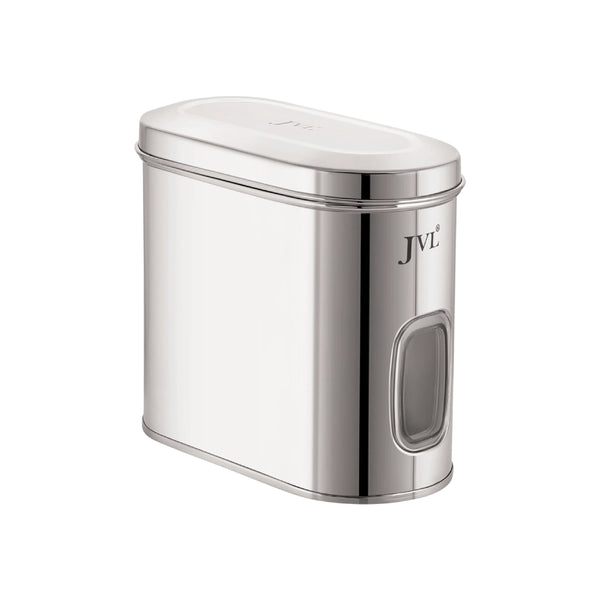
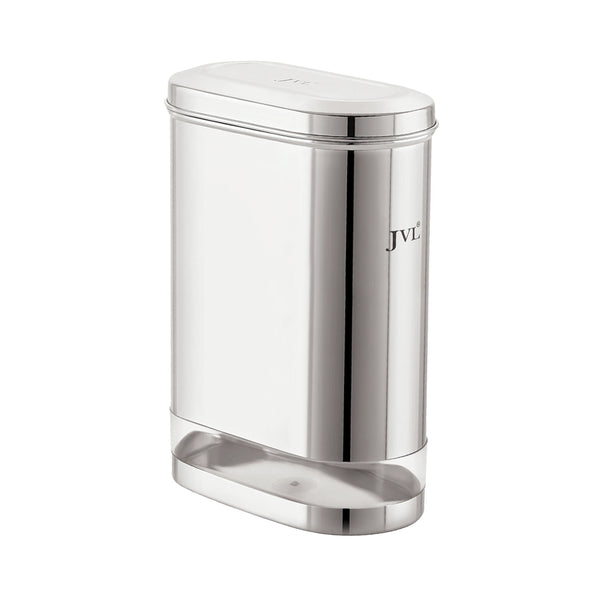
The Vintage Clear Canister is that jar. The clear panel design allows the contents to be identified at a glance without opening the jar — which matters practically during cooking when speed and accuracy both count. The stainless steel body delivers the food-grade safety, rust resistance and airtight performance that the daily use requirements demand. And the vintage-inspired finish gives the jar a visual weight that makes it look like a permanent fixture rather than a temporary solution.
What the vintage clear canister delivers in daily kitchen use:
- Instant visual identification of contents through the clear panel — no guessing, no opening the wrong jar during cooking
- Food-grade steel body that maintains the freshness and flavour of every ingredient stored inside
- Airtight lid that keeps moisture, air and pests out through every day of daily use
- A design profile that suits both traditional Indian kitchen aesthetics and modern organised pantry setups equally
- Easy to wipe clean on the exterior — the steel surface releases kitchen dust and cooking residue without requiring effort
- For the ingredient that lives on the counter — tea, coffee, sugar, salt, a daily-use spice — this is the jar that makes that permanent counter presence something worth looking at rather than looking past.
The Vintage Clear Combo Set of 6 for the Kitchen That Deserves Real Organisation
A single jar improves one part of the counter. A matched set transforms the entire kitchen storage experience.
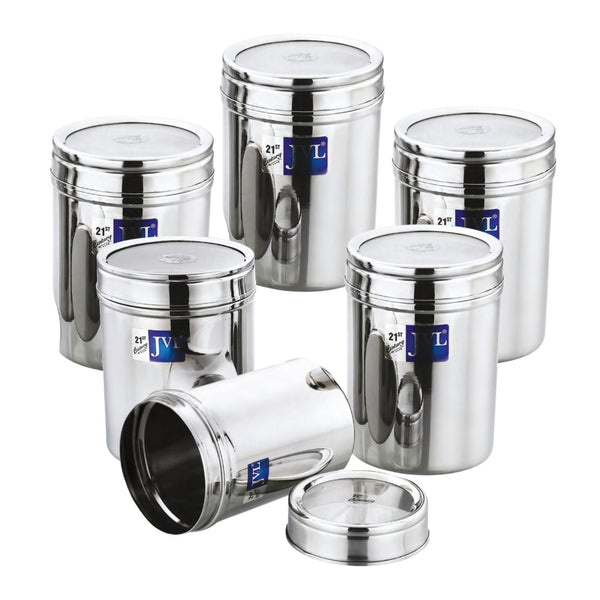
The Vintage Clear Combo Set of 6 is built for the household that wants to organise the full range of daily-use kitchen staples in one considered purchase. Six jars. Matching design. Consistent lid mechanism. Uniform visual identity across the full set.
What a set of six matching jars does for a kitchen that a single jar cannot:
- The full counter storage requirement — tea, coffee, sugar, atta, rice, a primary spice or dal — addressed in one purchase without mismatched additions later
- Every jar opens and closes the same way, removing the small friction of different lid mechanisms for different containers
- The visual uniformity of a matched set creates the kind of organised counter that makes cooking feel calmer before it begins
- Jars from the same set stack with consistent alignment, making vertical space in a cabinet or shelf usable in a way that mismatched jars never allow
- The clear panel on each jar means the full set can be identified at a glance — a counter that tells you what it holds without requiring any investigation
What the set covers for a standard Indian kitchen:
- Tea and coffee — daily-access hot drink staples that deserve a permanent, properly sealed counter position
- Sugar — accessed multiple times daily, needs a moisture-proof seal to stay granular through the year
- Salt — hygroscopic and best stored in a sealed container that prevents clumping in a humid kitchen
- Atta or rice flour — small counter quantity for daily use, bulk stored in a separate larger container
- A primary whole spice or dal — whatever is used frequently enough to warrant a dedicated counter position
The set of six provides enough jars to cover this range without excess and without gap.
How Countertop Organisation Changes the Experience of Cooking Every Day
The benefit of replacing mismatched kitchen jars with a matched set of stainless steel airtight jars reveals itself most clearly not in the first week, when everything is new, but in the months that follow — when the daily cooking routine has absorbed the change and the difference becomes visible in how the kitchen functions.
What changes in the first week:
- Every counter ingredient has a sealed, visually consistent jar that opens reliably every time
- The counter looks organised and considered rather than accumulated
- Cooking sessions move faster because ingredient identification is immediate
- What changes over the following months:
- Tea stays aromatic. Coffee stays fresh. Spices hold their potency longer than they did in previous containers
- Not a single jar has stained, rusted, or developed a failed seal — every lid performs exactly as it did when new
- The counter requires less daily reorganisation because everything has a fixed, logical position that the matched set reinforces visually
- Kitchen cleaning is faster because uniform jars wipe down in a single motion rather than requiring different techniques for different surfaces
What changes permanently:
- The low-level visual friction of a disorganised counter disappears — and with it, a layer of background stress that was present every time the kitchen was used
- The kitchen feels like a space that supports cooking rather than tolerating it
- Guests and family notice the difference in a way that goes beyond compliments — the organised counter communicates that the kitchen is managed with care
What to Look For Before Buying Any Kitchen Storage Jar
The kitchen jar market in India is wide and the quality range is equally wide. Knowing what separates a jar that will last from one that disappoints within a year protects the purchase decision before it is made.
Material and construction:
- Steel grade must be specified as food-grade 304 or 18/8 stainless steel — unspecified steel grades are a risk for long-term food contact use
- Interior finish must be smooth and polished — a rough interior holds residue and makes cleaning incomplete
- Exterior finish must be consistent and durable enough to withstand daily wiping without dulling or peeling
- Base construction must be stable enough to sit without rocking on a counter or shelf surface
- Lid and seal:
- Gasket material should be silicone rather than rubber for longer-lasting compression under daily temperature variation
- Lid fit must be snug with no rattle or movement when seated on the jar body
- The seal must be testable — close the jar, invert it, and see if air movement is perceptible. A genuine airtight seal produces none
- Lid design should allow one-handed opening for jars accessed during active cooking
- Design and sizing:
- Clear panel or window design allows content identification without opening — a practical advantage during cooking
- Sizing should match the actual quantities stored — a jar too small for a week's supply of sugar creates a restocking burden
- A matched set should share consistent lid mechanisms and visual identity across all sizes
- Stackability should be verified before purchasing if the jars will be stored in a cabinet rather than displayed on a counter
Explore the full range of airtight, rust-free storage options in the canisters and jars collection at JVL Classicware and find the set that brings real order to your kitchen counter.
The Counter That Finally Looks the Way the Kitchen Deserves to
A kitchen counter tells a story. When it is covered in mismatched containers, temporary packaging and accumulated solutions, the story it tells is one of a kitchen that is managed reactively — one purchase at a time, one problem at a time, without an overall vision of how the space should work.
A counter organised with a matched set of food-grade stainless steel kitchen jars tells a different story. It says that the kitchen was thought about. That the storage was chosen rather than accumulated. That the person who cooks here cares about the space as much as the food that comes out of it.
That counter is not a luxury. It is what happens when the right jars replace the wrong ones — and the right jars, as it turns out, are the ones built to last, sealed to perform and designed to make the kitchen look exactly like the space it deserves to be.
Frequently Asked Questions About Steel Kitchen Jars
Are stainless steel kitchen jars safe for storing spices and food long term?
Yes. Food-grade 304 stainless steel is completely non-reactive, which means it does not interact with any ingredient — including acidic spices, salt-heavy condiments or hygroscopic staples like sugar and atta — regardless of how long they are stored. The surface is also non-porous, so it does not absorb odour or flavour from previous contents. This makes steel jars one of the safest long-term storage options available for Indian kitchen use.
What is the difference between a steel jar with a clear panel and a fully steel canister?
A steel jar with a clear panel — like the Vintage Clear Canister — allows you to identify the contents at a glance without opening the jar. This is a practical advantage during active cooking when speed matters. A fully opaque steel canister offers the same food safety and seal performance but requires labelling or memory to identify contents. For counter storage where jars are accessed frequently, the clear panel design typically works better. For pantry shelf storage where jars are accessed less often, either format works equally well.
How do I know if a kitchen jar is genuinely airtight?
The most reliable test is simple. Fill the jar with the intended ingredient, close the lid fully and invert it for thirty seconds. A genuinely airtight seal produces no movement of contents, no seepage and no perceptible air exchange. A jar that only appears airtight when upright will show its weakness in this test. Additionally, a proper airtight jar should use a silicone gasket rather than a bare metal-on-metal seal or a thin rubber ring, as silicone maintains its compression across years of daily temperature variation.
Can I store wet or semi-wet ingredients in a stainless steel jar?
Steel jars are primarily designed for dry ingredient storage — spices, grains, flours, sugar, tea, coffee and similar pantry staples. While the steel itself is waterproof and non-reactive with wet ingredients, the lid seal on most steel canisters is optimised for dry storage rather than liquid containment. For wet chutneys, pickles or liquids, a purpose-built airtight steel container with a fully sealed screw lid is more appropriate than a standard canister-style jar.
How should I clean stainless steel kitchen jars?
Steel kitchen jars are straightforward to clean. For dry ingredients like flour, sugar and spices, a dry cloth or soft brush to remove residue followed by a wipe with a barely damp cloth is sufficient. For a full wash, warm water and a mild dish soap applied with a soft sponge cleans the interior completely — the non-porous surface releases residue without scrubbing. Avoid abrasive cleaning pads that scratch the polished interior finish. Dry the jar and lid completely before returning it to use to prevent any moisture from affecting the stored ingredient.
How many jars do I actually need to organise an Indian kitchen counter?
For a typical Indian household, a set of six jars covers the essential counter storage range comfortably. This accommodates tea, coffee, sugar, salt, atta or rice flour and one primary spice or dal that is accessed every day. Bulk quantities of rice, atta and multiple dals are better suited to larger dedicated storage containers rather than counter jars. If your counter storage needs extend beyond six items, a second set or a combination of different sizes from the same range ensures visual consistency while covering the additional requirement.