
Posted by Jvl Classicware
on July 18, 2026

Every morning in Indian kitchens, someone is standing at the stove watching milk. Waiting for it to boil. Hoping it doesn't spill over. Listening for a signal that never comes. This is not an unavoidable part of cooking. It is what happens when the milk boiler chosen for the kitchen was selected for its price tag alone, with no thought for what it is actually built to do.
If you are researching milk boiler price before you buy, this article will help you understand what the numbers actually measure. The JVL Classicware milk boiler collection offers food-grade stainless steel options built across multiple sizes and configurations starting from Rs. 768, designed to match every household's daily routine and budget. Whether you need the added stability of a milk boiler double handle for larger batches or a lighter Milk Boiler - Single Handle for compact everyday use, understanding what separates price points will help you spend with confidence and without regret.
What the Milk Boiler Price Range in India Is Actually Measuring
The milk boiler price in India spans a wide band and the difference between the lowest and highest numbers in that band is not random. It reflects a set of very specific product decisions including material grade, wall construction type, signalling mechanism, handle quality, available capacity, and finish standard.
At the entry level, you find basic single-wall stainless steel vessels with plain lids and no alert system. They keep the price low but they require your full attention throughout every boiling cycle. If your attention shifts for even a few seconds, the milk is on the stove. At mid-range price points, double wall construction and a whistle alert mechanism become standard. These two features together represent a fundamental change in how the vessel performs under real kitchen conditions. At the upper accessible price tier, larger capacities, induction-compatible bases, polished finishes, and verified food-grade steel become part of the offer. The JVL range sits comfortably across this mid-to-upper segment, providing double wall construction and whistle alert at a price point that does not ask you to compromise on material quality.
Double Wall Construction Is the Feature That Earns Its Place on the Price Tag
Double wall construction is the single most important structural feature in a quality stainless steel milk boiler, and it is a primary driver of the price difference between basic and better options available in the Indian market.
In a single-wall vessel, heat conducts directly through the steel body and reaches the outer surface quickly. The exterior becomes dangerously hot during boiling. Heat distribution through the base is also less even, which increases the risk of milk scorching at the bottom before it reaches the top. In a double-wall milk boiler, an inner and outer steel layer are separated by a deliberate insulating gap. This design performs two functions. It keeps the outer body significantly cooler during boiling, reducing the risk of surface burns when the vessel needs to be moved. It also distributes heat more evenly across the base so milk heats uniformly without developing hot spots that lead to burning or sticking.
JVL milk boilers are built with double-wall stainless steel construction as a standard feature across the entire range. For a household that boils milk twice a day, the difference in daily safety and cooking quality between single-wall and double-wall design becomes apparent from the very first week of use.
The Whistle Alert That Gives You Your Mornings Back
The whistle alert on a stainless steel milk boiler is one of those features that sounds simple until the first morning you actually use it. Then you realize exactly what you have been giving up in every previous morning routine where the vessel had no signal at all.
When milk reaches boiling point it rises very quickly. There is almost no visible warning before it spills. Without a whistle alert, the only reliable way to catch it is to stand and watch the stove continuously. With a loud whistle alert, you hear the signal the moment the milk reaches temperature and you respond from wherever you are in the kitchen. Morning routines in Indian households involve multiple tasks happening at the same time. Chai, breakfast, school bags, lunch box packing. The whistle alert is not a luxury feature. It is the feature that makes the milk boiler actually functional in those real-world conditions.
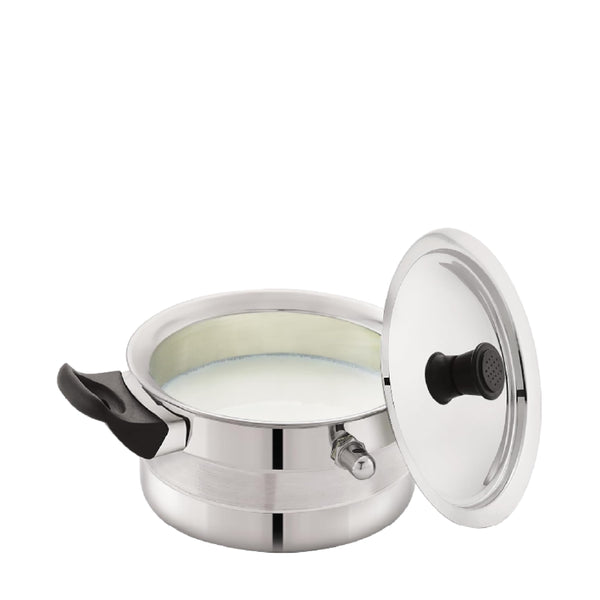
JVL milk boilers include a loud whistle indicator built into the lid design, calibrated to trigger clearly and audibly the moment boiling begins. This is the feature you will appreciate most on the first morning you step away from the stove and the whistle tells you exactly when to come back.
Why Stainless Steel Milk Boilers Justify Every Rupee Over Cheaper Materials
The material question matters more for milk boilers than it does for most kitchen vessels because milk is consumed daily, heated in the same vessel twice a day, for years on end. Whatever contacts the milk at high temperature every single morning is worth paying serious attention to.
Aluminium is the most common cheaper alternative to stainless steel in the Indian market. It costs less to produce and the retail price reflects that. But aluminium is a reactive metal. Under repeated high-temperature exposure it can oxidize, and this process can affect the taste and quality of what the vessel heats over time. Some lower-grade options also include plastic components that degrade under sustained heat, becoming brittle or off-gassing compounds that you do not want near daily-consumed food.
Food-grade stainless steel, specifically 18/8 grade which JVL uses across its milk boiler range, is fully inert. It does not react with milk at any temperature. It does not impart taste, odour, or any substance into the liquid it heats. It does not corrode, rust, or discolour under normal kitchen use. The milk boiler price for food-grade stainless steel options in India is higher than for aluminium equivalents, but what you are paying for is the material quality of every cup of milk your family drinks from that vessel across the next several years.
How Capacity Shapes the Price and What Size Your Kitchen Actually Needs
Capacity is one of the clearest and most straightforward price drivers in the milk boiler category. More volume requires more steel, heavier gauge construction, and in most cases reinforced handle systems to safely manage the filled weight during pouring.
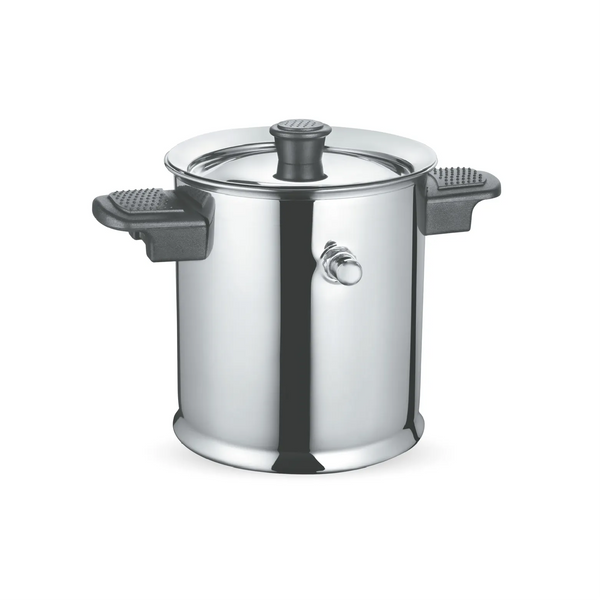
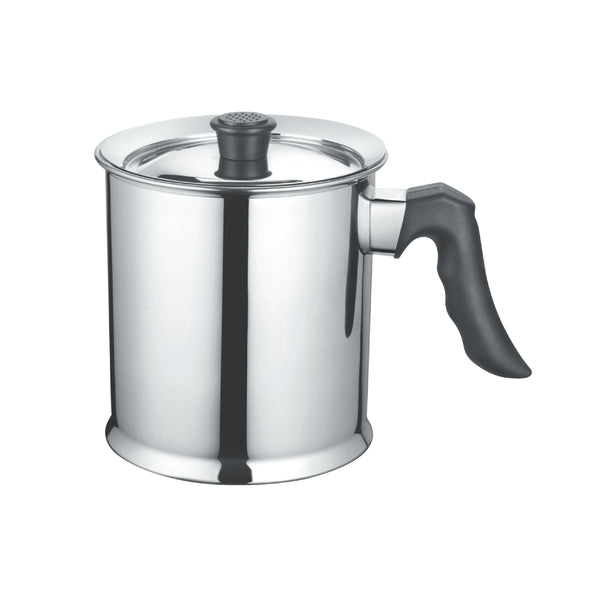
The JVL double handle milk boiler covers capacities from 1 litre through to 3 litres. The 1L and 1.5L sizes suit compact households of two to three people where milk is boiled in single daily portions. The 2L and 2.5L sizes work well for families of four where morning preparation covers tea, direct consumption, and occasional cooking use. The 3L option is built for larger households or joint family setups where milk is boiled in significant volume each morning. The single handle configuration covers 1L to 2L, making it the right choice for smaller daily requirements where a lighter vessel is a practical benefit.
Matching capacity to actual daily use also keeps stove time efficient. Boiling 3 litres in a 1.5 litre vessel means running two cycles. Buying more capacity than you use means longer heating time and unnecessary storage bulk. This is one of the most practical decisions in the milk boiler price-to-value calculation.
Handle Design Matters More to Daily Safety Than Most Buyers Realize
Handle configuration is a detail many buyers skip over when comparing milk boiler price options online, but it affects daily safety and comfort in ways that only become clear during actual use rather than at the point of purchase.
A double handle design gives you two contact points when lifting and pouring a full vessel. This matters most when the boiler is at maximum capacity and you need to carry it from the stove to the dining area or pour into multiple cups without losing control of the angle. The cool-touch bakelite handles on JVL milk boilers ensure that even after sustained boiling on a gas flame, the handles remain safe to grip without a cloth or mitt. A single handle design offers a lighter profile and suits capacities of 1L to 2L where the filled weight is easily managed with one hand.
Both handle configurations in the JVL range share the same food-grade double-wall stainless steel body, the same loud whistle alert, and the same curved edge pour design that channels milk cleanly without drips or spills. The handle is the only structural difference between the two, and it is a choice about your kitchen's daily use pattern rather than a trade-off on any other feature.
JVL Stainless Steel Milk Boilers and the Value Standard They Set in India
JVL Classicware brings more than 40 years of manufacturing experience and a dedicated R&D function to its kitchenware range, and the milk boiler collection reflects that depth. With a trust base of over 10 lakh families across India, the brand approaches milk boiler design as a daily-use problem to solve, not as a commodity to produce at minimum cost.
The result is a milk boiler range that delivers double-wall stainless steel construction, a loud whistle alert, cool-touch bakelite handles, a curved anti-spill pour edge, rust-proof finish, and food-grade 18/8 steel across multiple capacities, all starting from Rs. 768. At that price point, this is not a budget product with budget compromises. It is a considered product built for the specific conditions of Indian kitchens whether that is a gas flame in a traditional home or an induction cooktop in a modern flat. The value it delivers per rupee spent becomes clearer with every morning it performs exactly as it should.
What Smart Buyers Always Check Before Adding to Cart
Buying a milk boiler online in India gives you more options than any retail shelf carries locally, but it means evaluating features without handling the product. Before you add to cart, confirm these four things explicitly in the product description:
- Steel grade should be food-grade, listed as 18/8 or 18/10 stainless steel
- Wall construction should be double-wall, not single-wall
- Lid should include a built-in whistle alert mechanism
- Handle material should be heat-resistant bakelite, not bare metal
Beyond these, match capacity and handle configuration to your household size and daily boiling volume. All of these specifications are clearly stated in the JVL product listings so there is no guesswork before purchase.
She Deserves a Kitchen Tool That Works as Hard as She Does
The right milk boiler price is not the lowest number on the page. It is the price that reflects the features that make daily boiling safe, efficient, and genuinely worry-free. Double wall construction, a loud whistle alert, food-grade 18/8 stainless steel, cool-touch bakelite handles, and the capacity your household actually needs are not extras. They are the baseline for a vessel that earns its place in an Indian kitchen for years rather than months.
Explore the full stainless steel range at the JVL Classicware milk boiler collection. For dual-grip stability and larger capacities up to 3 litres, the milk boiler double handle is built for households that want confidence in every pour. For a lighter single-grip option in a compact 1L to 2L form, the Milk Boiler - Single Handle delivers the same food-grade stainless steel quality with a profile that suits smaller daily routines.
Every rupee spent on a milk boiler that performs correctly is a rupee that will not need to be spent again on replacing one that doesn't.