
Posted by Jvl Classicware
on August 07, 2026

Open any Indian kitchen cabinet and you will find the same story repeating itself. A plastic container that has gone cloudy and smells faintly of last month's sambar. A non-stick kadhai with a scratch running through the middle of it. A spice box with a lid that no longer closes properly. Three different chopping gadgets, none of which survived a year.
None of these failed because you used them wrong. They failed because the material was never built for the way Indian kitchens actually work — high heat, acidic tomato and tamarind bases, daily washing, humid monsoon months, and a family that cooks fresh food two or three times a day.
This is exactly why stainless steel kitchen accessories have quietly become the default upgrade for households that cook seriously. Not as a nostalgic return to your mother's kitchen, but as a practical, hygiene-driven, cost-per-year decision.
This guide breaks down what to look for, what to buy, in what order, and how to build a complete steel kitchen without replacing everything in one weekend.
Why Indian Kitchens Are Moving Back to Stainless Steel
The shift is not driven by trends. It is driven by three specific problems that Indian home cooks run into again and again.
The Plastic Problem
Plastic storage looks convenient at the point of purchase. Two years later it behaves very differently.
- Odour absorption: Masala, ghee and pickle oils permanently embed themselves into the plastic wall.
- Staining: Turmeric and tomato-based leftovers leave marks that no amount of scrubbing removes.
- Heat sensitivity: Hot dal or freshly cooked rice poured into plastic causes warping and, over time, degradation of the container surface.
- Structural fatigue: Lids stop sealing, snap clips break, and the container becomes a half-useful object taking up shelf space.
Health awareness has accelerated this shift. BPA-free labelling helped, but most buyers have moved past the label debate entirely and simply chosen a non-reactive material instead.
The Non-Stick Coating Question
Non-stick cookware has a genuine use case — dosas, omelettes, low-oil cooking. The problem is lifespan. Indian cooking involves steel ladles, high flame, dry roasting and vigorous stirring. Coatings are not designed to survive that. Once a coating is scratched, the utensil is functionally finished, and most households keep using it anyway because it still "looks fine."
Stainless steel has no coating to lose. That single fact changes the entire ownership equation.
What Steel Does Differently
Food-grade stainless steel is non-reactive. It does not interact with acidic ingredients like tomato, lemon, tamarind, curd or vinegar. It does not leach into food, does not absorb smell, and does not hold colour. It handles direct flame, oven heat, refrigeration and the dishwasher without changing its properties.
For a cuisine built on acidic gravies and high-heat tadka, that is not a small advantage. It is the entire point.
Understanding Steel Grades: 304, 202 and 18/8 Decoded
This is where most buyers get confused, and where most cheap products hide their weakness. A quick decode:
- 304 / 18-8 stainless steel — 18% chromium, 8% nickel. This is the international benchmark for food contact. Highest corrosion resistance, best shine retention, safest for storage and cooking.
- 202 stainless steel — Lower nickel content, manganese substituted in. Cheaper, more prone to pitting and dullness over time, especially with salt and moisture exposure.
- 430 stainless steel — Magnetic, low nickel, commonly used for induction bases and budget serveware. Fine for structure, weaker for long-term food storage.
What "Food-Grade" Actually Means
Food-grade is not a marketing adjective. It refers to steel that meets defined migration limits — meaning the metal does not transfer measurable material into food under normal use, heat and acidity. When a brand states 304 grade or 18/8 explicitly rather than just saying "high-quality steel," that is a signal worth trusting.
How to Check Quality Before You Buy
- Weight test: Better gauge steel has noticeable heft. Very light, tinny products flex easily and dent on impact.
- Edge finish: Run a finger along rims and seams. Quality manufacturing leaves rolled, smooth edges — never sharp burrs.
- Base construction: For cookware, look for a thick or encapsulated base. Thin bases cause hot spots and scorching.
- Joint quality: Handles and hinges should be riveted or properly welded, not spot-glued.
- Magnet check: Useful for identifying grade families, though not a standalone quality test — many 304 items are non-magnetic and still superior.
The Complete Kitchenware Checklist, Zone by Zone
The most effective way to plan a steel kitchen is not by product category but by workflow zone. Here is how a functioning Indian kitchen actually breaks down.
Zone 1 — The Prep Station
This is where 60% of your kitchen time is spent, and where most households under-invest.
- Vegetable chopper or dicer
- Mixing and marination bowls in nested sizes
- Colander and strainer
- Grater with multiple blade faces
- Measuring cups and spoons
- Lemon squeezer and garlic press
Zone 2 — The Cooking Line
- Kadhai and deep frying pans
- Saucepans in 1L, 1.5L and 2L
- Tope and patila sets for rice, dal and milk
- Steamer inserts for idli, momo and dhokla
- Tawa for roti and paratha
- Ladles, skimmers, turners and tongs
Zone 3 — Storage and Pantry
- Airtight canisters for atta, rice, sugar, pulses
- Spice containers with visibility
- Masala dabba with inner bowls
- Refrigerator-safe storage bowls with lids
- Oil and ghee dispensers
Zone 4 — Serving and Table
- Serving bowls with lids
- Casseroles and hot pots
- Water bottles and jugs
- Thali sets and dinner plates
- Tea and coffee serveware
You do not need everything at once. But knowing the full map stops you from buying random pieces that never form a system.
Prep Zone Deep Dive: Where Steel Earns Its Money Fastest
If you only upgrade one zone this year, make it prep.
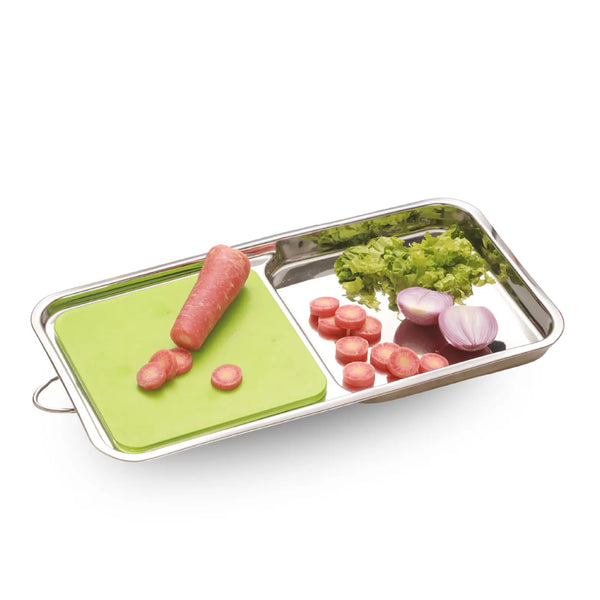
Plastic choppers are the single most replaced item in Indian kitchens. The blade housing cracks, the pull-cord snaps, the bowl scratches and clouds, and the onion smell becomes permanent. A steel-bodied chopping solution solves all four problems simultaneously.
A Rectangular Vegetable Chopper is worth calling out specifically because of its shape. Round choppers waste corner space and force you to work in small batches. A rectangular working surface handles longer vegetables — bhindi, beans, carrots, capsicum — in fewer passes, which meaningfully cuts prep time for a family-size meal. The steel body also means you can pour hot ingredients in without worrying about warping.
What good prep tools change in practice:
- Fewer transfers between vessels, so fewer things to wash
- Consistent cut sizes, which means even cooking
- No odour carryover between garlic prep and fruit prep
- Tools that survive being washed by anyone in the house, not just carefully
Storage That Solves the Real Problem: Visibility
Most spice storage fails not because it leaks but because you cannot see what is inside. You end up opening four containers to find jeera, and in the process you leave three lids loose.
This is why a Spice Tin with See-Through Lid is a genuinely underrated upgrade. The steel body protects the spice from light degradation while the transparent lid gives you instant identification. You get the shelf life benefits of opaque storage with the speed benefits of clear storage.
Storage principles worth following:
- Airtight beats attractive. A good seal preserves aroma; a pretty container that breathes does not.
- Uniform sizing beats variety. Matching footprints let you stack and slide without rearranging shelves.
- Steel near heat, always. Any container that sits near the stove will experience heat cycling. Plastic is the wrong material for that shelf.
- Label the base, not the lid. Lids get swapped. Bases do not.
Induction Compatibility: What Actually Matters
Induction adoption in Indian homes has grown fast, and it changes buying criteria. An induction hob only works with magnetic base material. Many stainless steel vessels are non-magnetic in the body but are built with a magnetic base layer specifically for this reason.
Before buying cookware, check for:
- A stated induction-compatible marking
- A flat, undistorted base — warped bases lose contact and heat unevenly
- Base diameter that matches your hob's coil size
- Encapsulated tri-ply or sandwich bottoms for even heat distribution
Prep and storage accessories obviously do not need this, which is why induction households often upgrade cookware and accessories on separate timelines.
Care and Maintenance: Making Steel Last Fifteen Years
Steel is forgiving, but it is not indestructible. A few habits protect the finish permanently.
- Avoid steel wool on polished surfaces. Use a soft scrubber; save abrasives for burnt bases only.
- Dry after washing. Water spots and mineral deposits come from air-drying in hard water areas, not from the steel itself.
- Do not store salt or salted food for long periods. Prolonged salt contact can cause pitting even on quality steel.
- Remove burnt residue with baking soda and hot water, not with knives or metal scrapers.
- Deal with rainbow discolouration using diluted vinegar. That heat tint is cosmetic, not damage.
- Never store acidic food overnight in any vessel — good practice regardless of material.
A Phased Plan: Building Your Set Without a Single Big Bill
Replacing an entire kitchen at once is unnecessary and expensive. This sequence gets you the fastest quality-of-life improvement per rupee.
Phase 1 — Prep and daily-touch items Chopper, mixing bowls, colander, essential ladles. These are used every single day, so the upgrade is felt immediately.
Phase 2 — Spice and dry storage Spice tin, masala dabba, atta and rice canisters. This is where hygiene gains are highest.
Phase 3 — Core cookware Kadhai, two saucepans, one tope. Replace only the pieces you actually reach for.
Phase 4 — Refrigerator and leftovers Lidded storage bowls to retire the last of the plastic.
Phase 5 — Serveware Casseroles, serving bowls, jugs. Aesthetic and hosting upgrade rather than functional necessity.
You can explore the full range of stainless steel kitchen accessories and build your phases around what your kitchen actually lacks.
Five Mistakes That Waste Money on Steel
- Buying a giant combo set. Most sets include three pieces you will never use. Buy by function, not by count.
- Ignoring gauge thickness. Two products can look identical online and differ completely in the hand.
- Mixing incompatible sizes. Storage that does not stack costs you shelf space forever.
- Assuming all steel is 304. Ask. Good brands answer clearly.
- Keeping the damaged non-stick "just for now." That "for now" usually lasts two more years.
The Bottom Line
Building a stainless steel kitchen is not about buying everything at once or throwing out what still works. It is about making sure that every time something breaks, cracks, stains or scratches, you replace it with a material that will not repeat the same failure.
Start with the prep zone because it is used most. Move to spice and dry storage because that is where hygiene matters most. Let cookware and serveware follow at their own pace.
Ten years from now, a well-chosen steel kitchen looks almost exactly the way it did on day one. That is the entire argument, and for Indian homes that cook every single day, it is a strong one.
Browse the complete JVL Classicware range of stainless steel kitchen accessories and start with the one zone that frustrates you most.
Frequently Asked Questions
Is stainless steel really safer than non-stick cookware?
Stainless steel has no surface coating that can chip, scratch or degrade with heat, which removes the primary safety concern people have with worn non-stick. Food-grade steel is non-reactive and does not transfer material into food under normal cooking conditions.
What steel grade should I look for in kitchen accessories?
304 grade, also written as 18/8, is the benchmark for anything that touches food regularly. It offers the best combination of corrosion resistance, durability and food safety for Indian cooking conditions.
Will stainless steel storage keep spices fresh?
Yes, and often better than plastic. Steel blocks light completely, does not absorb aroma oils, and maintains a stable internal environment. A tight-sealing lid is the deciding factor for freshness.
Can I use stainless steel on an induction cooktop?
Only if the vessel has a magnetic base. Check for an explicit induction-compatible marking and a perfectly flat bottom before buying.
Why does my steel utensil have rainbow-coloured patches?
That is heat tint, a harmless oxide layer that forms when steel is heated dry or at high temperature. Wiping with diluted white vinegar removes it completely.
Are steel vegetable choppers better than plastic ones?
For Indian kitchens, generally yes. Steel bodies do not crack under pressure, do not stain from turmeric or beetroot, do not retain onion and garlic odour, and tolerate hot ingredients without warping.
Is stainless steel dishwasher safe?
Quality food-grade steel is dishwasher safe. Use a mild detergent and remove items before the extended heat-dry cycle to prevent water spotting in hard water areas.
How do I stop water spots on my steel utensils?
Dry them with a cloth immediately after washing. Water spots are mineral deposits from your water supply, not a defect in the steel.
Does stainless steel rust?
Properly graded stainless steel is rust-resistant, not rust-proof. Prolonged exposure to salt, harsh chemicals or abrasive damage to the surface layer can cause pitting. Normal care prevents this entirely.
Is switching to steel more expensive overall?
Higher upfront, lower over time. A steel accessory that lasts ten to fifteen years replaces three or four plastic equivalents and one or two non-stick pieces in the same period.