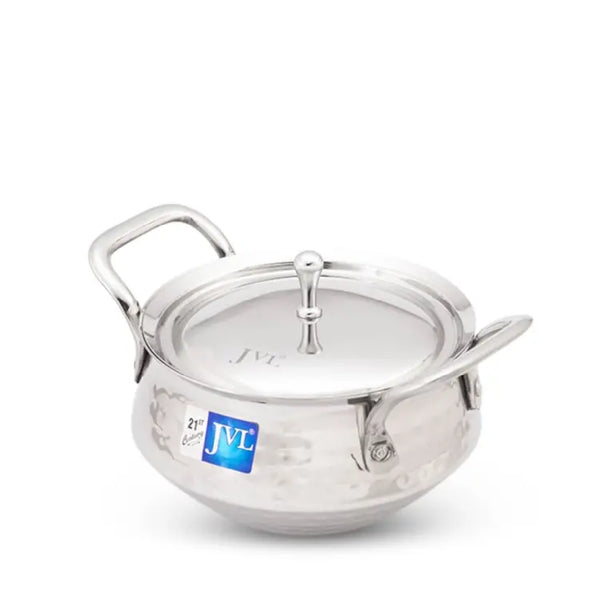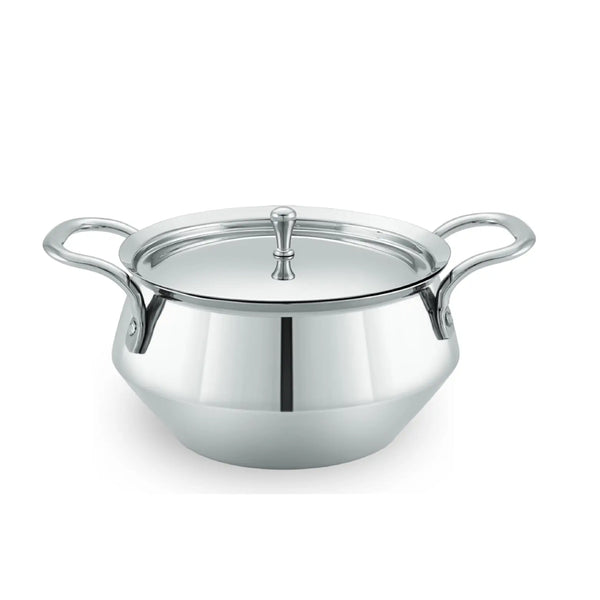

Posted by Jvl Classicware
on August 24, 2026

It was the third time she had replaced the same kadai. Not the same brand. The same category — non-stick, mid-range, the kind that looks perfect in the first month and begins its quiet deterioration in the second. The coating that starts flaking at the edge near the handle. The base that develops a hot spot that burns onions while the rest of the oil sits cold. The instruction not to use metal utensils that becomes impossible to follow during a fast-moving tadka.
She had accepted this cycle as the cost of cooking. Buy it. Use it carefully. Watch it degrade. Replace it.
The day she switched to a triply stainless steel kadai was the day that cycle ended. Not because a steel kadai is simply a better non-stick. Because it is a fundamentally different object that operates on a different set of principles — one that does not degrade, does not coat, does not require protective treatment and does not place a limit on how intensely or freely she can cook in it.
What a Triply Kadai Actually Is and Why the Three Layers Matter
The word triply refers to a three-layer bonded construction in which each layer performs a specific function that the other layers cannot. Understanding what each layer does is the fastest way to understand why a triply kadhai outperforms both single-layer stainless steel and non-stick aluminium in every condition that Indian cooking creates.
The three layers and what each one contributes:
The interior layer — food-grade 304 stainless steel — is the surface that contacts the food. It is non-reactive, non-porous and completely safe for the acidic ingredients that define Indian cooking. Tamarind, tomatoes, citrus, curd and vinegar-based preparations all cook in direct contact with this surface without any chemical interaction. No coating sits between the food and the steel. Nothing degrades, flakes or requires protection.
The middle layer — an aluminium core — is the heat conductor. Aluminium conducts heat approximately sixteen times faster than stainless steel alone. The aluminium core receives heat from the base and distributes it laterally across the entire cooking surface before it reaches the interior layer. This is what eliminates hot spots — the specific failure mode of single-layer steel kadais where heat concentrates at the point directly above the flame and burns food while the surrounding area stays cool.
The exterior layer — 430 stainless steel — is the induction interface. The 430 grade is magnetic, which is the property that induction cooktops require to generate heat. It is also highly durable and resistant to the discolouration that comes from direct flame contact over time.
The bonded construction means these three layers function as a single unified piece of metal. Heat moves through the exterior, spreads through the aluminium core and arrives at the cooking surface evenly distributed. This is not marketing language. It is the physics of thermal conductivity applied to cookware design.
Why Indian Cooking Specifically Needs Even Heat Distribution
The demand that Indian cooking places on a kadai is more varied and more intense than most global cuisines require of a single vessel. A single kadai in an Indian kitchen may be used for all of the following within a single week:
- Deep frying at sustained high temperatures — pakoras, poori, murukku, samosas
- Slow-cooking dal or sambar at a low, steady simmer for thirty minutes or more
- Tadka — the brief, intense flash of heat that blooms whole spices in hot oil in under thirty seconds
- Sautéing onions slowly until they reach the exact caramelisation a base curry requires
- Finishing a dry sabzi over high heat to develop the slightly charred edges that add flavour
Each of these cooking methods creates a different heat requirement. And the problem with a single-layer kadai — steel or aluminium — is that it cannot transition between these requirements without creating the hot spots and temperature inconsistencies that produce burnt garlic, undercooked centres and uneven frying results.
The aluminium core in a triply kadai solves this by acting as a thermal buffer. When the flame is high, the core absorbs and distributes the excess heat before it concentrates. When the flame is low, the core retains and distributes the stored heat evenly. The cooking surface maintains a more consistent temperature than the flame itself — which is precisely what each of the cooking methods above requires to produce the correct result.
The Non-Stick Comparison Every Buyer Deserves to See
The most common purchase context for a triply stainless steel kadai is a replacement for a worn-out non-stick. And the most important thing to understand about that replacement is that it is not a lateral move between two equivalent options. It is a move from a coated surface with a limited lifespan to an uncoated surface with no lifespan limit.
What non-stick coatings do over time:
- PTFE-based non-stick coatings begin degrading at temperatures above 260 degrees Celsius — a temperature easily reached during deep frying and tadka in Indian cooking
- As the coating degrades, it releases PFOA and other fluoropolymer compounds into food and into the kitchen air
- Physical degradation — scratching, flaking, peeling — begins when metal utensils contact the surface, when the kadai is scrubbed during cleaning or when the base is overheated
- Once the coating is visibly compromised, the kadai is both less functional and actively introducing degraded coating material into food
- Replacement becomes necessary every twelve to twenty-four months in a kitchen where the kadai is used daily under Indian cooking conditions
What a triply kadai does instead:
- No coating means nothing to degrade, flake, release or replace
- Metal utensils — ladles, spoons, slotted spatulas — can be used without any concern
- The cooking surface is the same on day one thousand as on day one
- High-heat deep frying and tadka produce no reaction in the steel surface
- PFOA-free and PTFE-free by construction — not as a certification achieved, but as a material reality
- Dishwasher safe, scrub safe and suitable for any cleaning method without surface damage
The triply kadai costs more than a non-stick alternative at the point of purchase. Over three years of daily use, during which the non-stick kadai has been replaced at least once and possibly twice, the steel kadai has not required any replacement. The long-term cost comparison always resolves in favour of triply steel.
The Cookwell Full Copper — Where Design and Performance Meet
A triply stainless steel kadai in the right construction performs consistently regardless of finish. But the finish is what makes the piece feel like a considered addition to the kitchen rather than a utilitarian tool that happens to work well.
The Cookwell Full Copper brings copper finish to the triply construction — a combination that serves both the visual and the functional brief simultaneously.
The copper exterior is not decorative plating over inadequate construction. The triply base construction underneath delivers the aluminium core heat distribution and 304 stainless steel interior that the cooking performance requires. The copper finish on the exterior brings a warmth and visual richness to the kitchen that stainless steel alone does not produce — and one that looks as appropriate on a counter or a serving surface as it does on the stove.
What the Cookwell Full Copper delivers in daily cooking:
- Even heat distribution from the triply construction that eliminates the hot spots and burning that single-layer kadais produce
- Food-grade 304 stainless steel interior that handles every Indian cooking scenario — acidic curries, high-heat frying, slow simmering — without any surface concern
- Copper finish exterior that transitions from stove to table without looking like cookware that needed to be hidden before guests arrived
- Capacity designed for family-scale Indian cooking — generous enough for a full dal or a batch of fried snacks without crowding
- Weld-free handle design that does not create the weakness point that welded handles develop over high-heat use cycles
For the household that wants cooking performance and visual quality in the same piece, the Cookwell Full Copper is the kadai that does not ask you to choose between them.
The Cookwell Mirror Finish for the Kitchen That Values Clean Elegance
The mirror finish stainless steel exterior is the other direction a triply kadai can go — not the warmth of copper but the cool, reflective precision of polished steel that looks considered in a modern kitchen.
The Cookwell Mirror Finish delivers the same triply construction performance with a mirror-polished exterior that reflects light cleanly and gives the kadai a presence on the stove that a brushed or matte finish does not.
What the mirror finish does beyond appearance:
- The polished exterior surface is easier to wipe clean than a brushed exterior because oil and cooking residue sit on the surface rather than entering the brushed texture
- The reflective surface shows fingerprints and water marks more readily than matte — a trade-off that most buyers accept for the visual quality the finish delivers
- The mirror polish is achieved through the steel itself rather than through an applied coating, which means it does not degrade or peel over time
- The same clean, non-reactive 304 stainless steel interior is present regardless of the exterior finish — cooking performance is identical across both versions
The choice between the Cookwell Full Copper and the Cookwell Mirror Finish is ultimately an aesthetic one. Both deliver identical triply construction performance. The copper finish suits warm, traditional kitchen aesthetics and looks exceptional as a serving vessel. The mirror finish suits modern, minimal kitchen design and maintains its appearance with straightforward regular cleaning.
Sizing Your Triply Kadai for the Way Your Family Cooks
The most common question before purchasing a triply kadai is sizing — and the answer depends on what the kadai will be used for most frequently and how many people it is cooking for.
For a family of two to three:
A 22cm to 24cm triply kadai covers the full range of Indian cooking needs at this household size. It provides enough depth for deep frying without requiring an excess of oil to reach the correct frying level, and enough surface area for a dal or sabzi without the food spreading too thin and cooking too quickly.
For a family of four to five:
The 24cm to 26cm range is the practical sweet spot for the majority of Indian household cooking. It handles a full batch of samosas, a complete dal for four servings, a generous quantity of stir-fried vegetables and a tadka at sufficient scale without requiring multiple rounds. This is the size most experienced home cooks recommend as the primary household kadai.
For larger families or batch cooking:
A 28cm or larger triply kadai is appropriate for households of six or more, or for cooks who regularly prepare food in advance or cook for guests. The wider base area provides more cooking surface for even browning of larger quantities of onions or vegetables.
Depth considerations:
A deep triply stainless steel kadai — with higher walls relative to its diameter — is specifically better for deep frying because the higher walls contain oil splash and allow food to be fully submerged without requiring a volume of oil that a shallower vessel would demand. If deep frying is a regular part of the household's cooking, depth should be weighted as highly as diameter in the sizing decision.
What to Check Before Buying Any Triply Kadai
The triply kadai category has expanded significantly in the Indian market, and not every product described as triply delivers the construction quality that the name implies. Knowing what to verify before purchasing protects the investment.
Construction verification:
- Steel grade should be specified — food-grade 304 stainless steel interior and 430 stainless steel exterior are the correct specifications
- The aluminium core should extend fully across the base and ideally partway up the sides — a core that covers only the base produces hot spots at the junction between the cored base and the single-layer walls
- Base thickness should be substantial — a triply base that flexes when pressed is not thick enough to distribute heat effectively
- Weld quality on handles should be clean and flush — rough or uneven welds indicate lower-quality construction and are the first point of failure under high-heat use
Handle and lid considerations:
- Stay-cool handles — handles that remain at a manageable temperature during stovetop use — are a meaningful practical feature for a kadai used at high heat
- A stainless steel lid rather than a glass lid withstands the high temperatures of Indian cooking without the thermal shock risk that glass lids carry when moved from a hot kadai to a cold surface
- Both handles should be symmetrically positioned and feel balanced when the kadai is lifted full — asymmetric handle positioning makes a heavy kadai unstable
Induction compatibility:
- The 430 stainless steel exterior required for induction compatibility is magnetic — a simple magnet test on the base of the kadai confirms compatibility before purchase
- Flat base construction is required for full induction contact — a base with any convex curve will not maintain full contact with an induction surface and will produce uneven heating
What the price tells you:
A genuine triply kadai in food-grade 304 steel with a full-coverage aluminium core cannot be produced cheaply. A triply kadai priced at the level of a standard single-layer steel kadai is either using a thinner aluminium core, a lower steel grade or a core that does not extend to the walls. The investment in a correctly constructed triply kadai is a ten-year cooking decision — the price point reflects that.
The Kadai That Earns Its Place on the Stove Every Single Day
The triply stainless steel kadai is not a specialist tool. It is the most versatile, durable and safe cooking vessel for the specific demands of Indian cooking — high heat, acidic ingredients, intensive daily use and the expectation that the same kadai will handle everything from a slow-simmered dal to a batch of deep-fried snacks without compromise in any direction.
The non-stick kadai it replaces required careful handling, produced limited cooking flexibility and eventually demanded replacement. The triply kadai requires none of the first, provides full cooking flexibility and never demands the second.
The day she threw away her last non-stick kadai was the day her kitchen stopped operating under the assumption that cooking equipment was something to be replaced on a cycle. The triply kadai is a one-time decision that changes every cooking session that follows it — and in a kitchen where the kadai comes out every single day, that change accumulates into something that is difficult to fully appreciate until it has been experienced.
Frequently Asked Questions
What is the difference between a triply kadai and a regular stainless steel kadai?
A regular stainless steel kadai is a single layer of steel throughout. It conducts heat poorly compared to aluminium, which means it develops hot spots where food burns at the centre while the edges remain cool. A triply kadai has three bonded layers — a 304 stainless steel interior, an aluminium core and a 430 stainless steel exterior. The aluminium core distributes heat evenly across the entire cooking surface, eliminating hot spots and producing consistent results across every cooking method.
Can I use metal utensils in a triply stainless steel kadai?
Yes, without restriction. The cooking surface of a triply kadai is food-grade 304 stainless steel — a hard, durable, uncoated metal surface that is not damaged by metal ladles, spoons, slotted spatulas or any other metal utensil. This is one of the primary practical advantages over non-stick alternatives, which require plastic or silicone utensils to avoid coating damage.
Is a triply kadai induction compatible?
A triply kadai with a 430 stainless steel exterior is induction compatible. The 430 grade is magnetic, which is the property induction cooktops require to generate heat. Confirm induction compatibility before purchasing by checking whether the manufacturer specifies 430 steel for the exterior layer, or by performing a magnet test on the base of the kadai — a magnetic base confirms induction compatibility.
Is a triply stainless steel kadai safe for deep frying?
Yes, and it is specifically well-suited for deep frying for two reasons. The aluminium core maintains a consistent oil temperature across the full base area, which produces more even frying results than a single-layer vessel where oil temperature varies across the surface. And the absence of any coating means there is no temperature threshold above which a surface compound degrades — the steel handles sustained high-heat frying without any surface concern.
How do I clean a triply stainless steel kadai after cooking?
For everyday cleaning, warm water and dish soap with a soft sponge removes cooking residue completely from the non-porous steel surface. For stubborn staining from high-heat cooking or caramelised residue, a paste of baking soda and water applied and left for ten minutes before scrubbing resolves the issue without damaging the surface. Avoid steel wool or abrasive pads on the polished interior — they leave micro-scratches that dull the finish over time without affecting cooking performance.
What size triply kadai is best for a family of four?
A 24cm to 26cm triply kadai is the most practical size for a family of four in an Indian household. This size handles a full dal, a complete batch of fried snacks and a stir-fried vegetable dish at family scale without requiring multiple rounds. If deep frying is frequent, prioritise a model with higher walls — depth matters as much as diameter for containing oil and achieving full submersion during frying.