
Posted by Jvl Classicware
on June 13, 2026

The plastic ones that turned yellow within a month. The ones with lids that stopped sealing after six weeks of daily use. The dabba that leaked sambar into the bottom of my office bag on a packed Monday morning train. The one that smelled of last Tuesday's curd rice no matter how thoroughly I washed it.
Every time I replaced one, I told myself I was being more careful this time. I read the reviews. I checked the seal. I picked the one with the better clip. And every time, within a season, I was back at the same problem.
The day I switched to a steel lunch box was the day that cycle ended. Not because steel is magical. Because steel is simply built differently — and once I understood why, I realised I had been buying the wrong thing for years without knowing there was a right thing available.
Why I Stopped Trusting Plastic With My Food
I did not switch to a steel lunch box because of a health article or a social media recommendation. I switched because I was tired of being let down in small, cumulative ways that added up to a lot of daily frustration.
Here is what plastic tiffins were doing to my routine without me fully connecting the dots:
- The interior of every plastic box I owned turned a permanent shade of orange-yellow within weeks of carrying turmeric-based dishes
- The smell of previous meals never fully left — I could always detect a faint trace of yesterday's dal in today's rice
- The lids developed micro-cracks at the stress points where I opened and closed them daily, and those cracks became the entry points for leaks
- Hot food packed directly into plastic softened the container slightly every time, and over months that deformation made the seal progressively worse
- I could never be fully confident the lid would hold in a crowded bag
What bothered me most was the last point. That low-level anxiety of not knowing — not being able to simply trust the container — is something I accepted as part of carrying lunch for years. It is not normal. It is a product failure that I had internalised as my problem.
A steel tiffin box removed every single one of these issues in the first week. The interior stayed clean. There was no smell transfer. The lid performed exactly the same way on day one hundred as it did on day one. And I stopped thinking about whether the bag was safe to tip sideways.
What Food-Grade Steel Actually Means for Everything Inside the Box
When I first started looking at steel lunch boxes, I kept seeing the term food-grade stainless steel and initially treated it as marketing language. It is not. It is a specific material designation that has direct consequences for the safety of every meal I pack.
Food-grade 304 stainless steel — the grade used in quality steel dabbas — is non-reactive. That means when my sambar, which contains tamarind, tomatoes and salt, sits inside the container for three hours during a commute, the steel does not interact with the acidity of the dish. There is no leaching. There is no metallic taste. The sambar arrives tasting exactly like it did when I packed it.
This matters specifically for Indian food because our cooking is naturally acidic and heavily spiced in ways that reveal material weaknesses quickly:
- Tamarind-based dishes react with aluminium and degrade plastic coatings over time
- High salt content accelerates corrosion in low-grade metals
- Turmeric and chilli oil penetrate porous materials and do not come out
- Citrus used in rice dishes, chutneys and marinades creates acidity that tests every surface it touches
Food-grade steel handles all of these without any degradation in safety or performance. It is BPA-free by nature — there are no plastic polymers to leach in the first place. And the non-porous surface means that even after years of daily use, the interior of my steel lunch carrier looks and performs exactly as it did when it was new.
The Leak-Proof Standard That Actually Held Up in Real Life
I have read the words leak-proof on more lunch box packaging than I can remember. And I have experienced more leaks than a product with that label should ever produce.
The difference between a genuine leak-proof lid and a marketing claim comes down to how the seal is engineered. A clip at one point on the lid concentrates the closing pressure at that single location. The rest of the perimeter is held by friction alone, which degrades as the plastic ages and the gasket loses its compression.
A full-perimeter locking lid distributes closing pressure evenly around the entire rim. The gasket — ideally silicone rather than rubber — maintains its elasticity across hundreds of open-close cycles. When the box is sideways in my bag, the seal holds because it was designed for that position, not just for sitting flat on a desk.
What I tested before trusting a steel lunch box completely:
- Packed with dal and carried sideways in a fully loaded bag for a one-hour commute
- Placed at the bottom of the bag with a laptop resting on top
- Opened and closed quickly under time pressure without careful alignment
- Carried by my daughter in a school bag that spent twenty minutes bouncing on her back
The steel tiffin box I now use passed every one of these without a single incident. The food that goes in comes out exactly as packed. The bag stays clean. That is the only proof of leak-proof performance that actually matters.
The Three-Tier Steel Box That Changed My Meal Packing
For most of my adult working life I packed lunch in two containers because I could not find one that held everything without compromise. Rice in one. Sabzi and dal in another. Two boxes, twice the washing, twice the space in my bag.
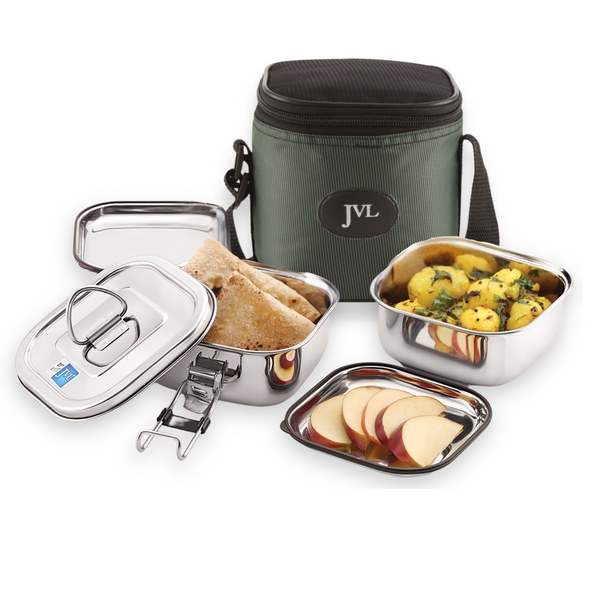
The Square Leak Proof Lunch Box Three level was the first steel lunch box I found that made a single container genuinely work for a complete Indian meal.
What changed for me with the three-tier format:
- Rice, sabzi and dal each sit in a fully separated tier with their own individual seal — nothing mixes until I choose to combine it at my desk
- The square geometry means it fits flush against the rectangular panel of my office bag without wasted space at the corners
- All three tiers stack into one compact unit that weighs less combined than my previous two-container arrangement
- Each tier seals independently, so even if I carry the whole stack at an angle, the contents of each level stay exactly where I put them
- The food-grade steel interior releases everything cleanly at wash time — a full three-tier clean takes me under two minutes at the sink
I packed a full lunch — rice, rajma, roasted vegetables and curd — on the first day I used it and carried it for a ninety-minute commute each way. Everything arrived exactly as packed. The curd did not overflow. The rajma did not reach the rice. I have not used a second container since.
The Day My Lunch Actually Arrived Hot
There is a specific frustration I lived with for years that I had stopped naming because it felt too ordinary to complain about. By the time I opened my tiffin at lunch, the food was lukewarm at best. On long office days or travel, it was cold. And cold dal and cold rice are a specific kind of disappointment that is hard to explain to someone who has not experienced it daily.
I assumed this was just how packed lunch worked. Heat leaves. Food cools. That is physics.
What I did not understand until I tried a vacuum-insulated steel lunch jar is that physics can also be used in the other direction. The Hot lunch box jar uses a vacuum layer between the inner and outer steel walls — the same principle as a thermos — to stop that heat loss from happening at a meaningful rate.
What I noticed from the first week of using it:
- Dal packed at seven in the morning was still genuinely hot at one in the afternoon
- Khichdi, which is particularly depressing when cold, arrived at my desk as a proper warm meal for the first time
- Soup that I had given up carrying because it always arrived cold became a regular part of my office lunch
- The wide mouth made it easy to fill quickly in the morning and easy to eat from directly at my desk
I now use the hot jar for any dish that needs to arrive warm and the three-tier steel box for the dry components. Together they cover every type of lunch I pack across the week.
What a Steel Lunch Box Does for a Child's School Tiffin
The standards I hold for my own office tiffin are the same ones I hold for my daughter's school dabba — except the stakes feel higher.
A child's steel meal box gets dropped. It gets opened in a rush. It gets stacked under other boxes in a bag. It gets carried by a strap in one hand while everything else is carried in the other. And the food inside needs to arrive safe, sealed and untouched by the bag lining or the tiffin of the child sitting next to her.
A rust-resistant steel tiffin box handles every one of these realities:
- Durable enough to survive the impact of a school bag being dropped without denting or cracking
- Sealed well enough that jostling and carrying at odd angles does not open the lid
- Safe enough that acidic dishes like lemon rice, curd rice and tamarind-based gravies travel without any material interaction
- Clean enough that five minutes of hot water and soap at the end of the school day leaves it completely ready for the next morning
What I noticed after switching my daughter's tiffin to steel is that she stopped coming home with an empty box and a stained bag lining. The food either came home uneaten — which tells me something about the menu — or arrived at school exactly as packed. The bag has been clean every day since.
How to Evaluate Any Steel Lunch Box Before Buying
Not every product labelled as a steel lunch box is built to the same standard. I learned this through experience and through looking more carefully at what actually separates a durable steel dabba from one that disappoints within months.
What to check before purchasing:
- Steel grade specified — food-grade 304 or 18/8 is the standard; anything unspecified is a risk
- Lid mechanism — full-perimeter locking outperforms any single-clip design for genuine leak prevention
- Gasket material — silicone holds elasticity and shape longer than rubber under daily heat and cold cycling
- Wall thickness — thinner steel dents under normal daily impact and loses heat faster
- Weld quality at the handle and base — weak welds are where rust begins in lower-grade products
- Interior finish — a smooth, polished interior releases food completely; a rough interior holds residue
What to avoid:
- Products that do not specify the steel grade on the listing or packaging
- Composite designs where plastic components contact the food directly
- Lids with a single clip or snap that creates uneven pressure around the seal
- Unusually low pricing that cannot support genuine food-grade steel construction
- Coatings or coloured finishes on the interior — they chip and enter food over time
The steel lunch box that earns daily use for years is built without any of these shortcuts. It is slightly heavier than a plastic alternative. It costs more at the point of purchase. And it pays that difference back within the first year through the simple absence of every problem plastic creates.
The One Purchase That Ended the Replacement Cycle
I bought my current steel lunch box eighteen months ago. I have used it every working day since. The seal performs exactly as it did in the first week. The interior shows no staining, no discolouration, no smell from any of the hundreds of meals it has carried. The lid opens and closes with the same ease and the same security it did on day one.
That is the thing I did not understand about a good steel tiffin box before I owned one. It does not degrade in the ways that made me accept replacement as part of the routine. It simply continues to do what it was built to do, day after day, without asking anything of me except to pack it.
If you have been through the same replacement cycle I described at the start of this article, the answer is not a better plastic option. It is the right steel one. Explore the full range in the Lunchbox Collection JVL Classicware and find the format that fits what you carry every day.
The steel lunch box you buy once is the one you use every single day — and eventually stop thinking about entirely, because it never gives you a reason to.