
Posted by Jvl Classicware
on November 18, 2026

A tiffin that sits on a kitchen shelf has an easy life. Someone fills it, carries it a few steps to a table, and washes it within the hour. A travelling tiffin faces none of that calm. Someone packs it hot, zips it into a bag, bounces it around on a train or a two-wheeler, leaves it in a locker for six hours, and finally opens it hoping the sabzi hasn’t migrated into the rice. That daily abuse is exactly why you should choose a travelling tiffin differently from an everyday lunch box, even when both use the same stainless steel.
What actually makes a tiffin travel-ready
Three things separate a travel tiffin from a box that merely happens to go out the door with you: a lid that holds under motion, a carrier frame that keeps multiple tiers from sliding apart, and a bag built to match the tiffin’s own shape rather than a generic sack. Miss any one of these and the other two stop mattering, since a perfectly sealed tier is still useless if the frame holding it to the tier below it pops loose in a crowded bus.
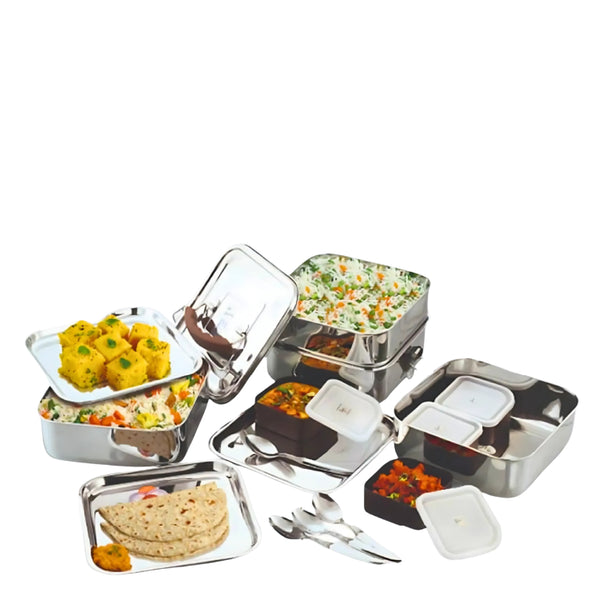
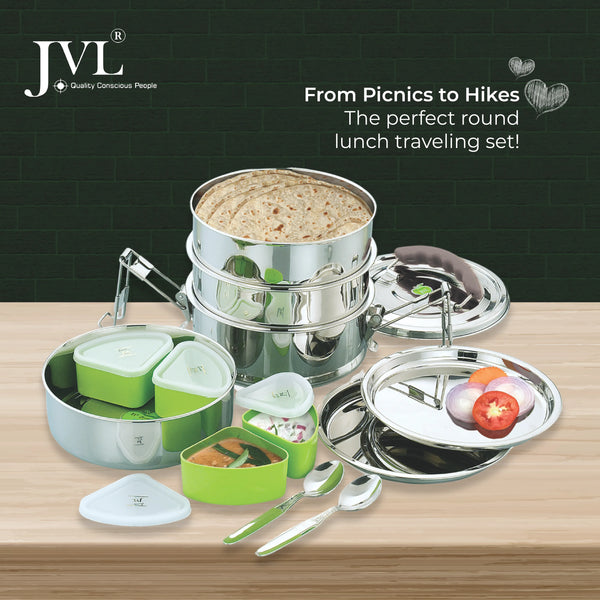
JVL builds its travelling range around that same logic: food-grade stainless steel tiers, leak-proof lids, and clip-lock carrier frames that hold the whole stack together as one unit rather than a set of containers hoping to stay stacked. The Square Travelling Lunch Box Set with Bag, a 4-tier set currently at ₹1,600 against a listed ₹2,000, and the Round Travelling Lunch Box Set with Bag, also 4-tier, at ₹1,560 against ₹1,950, each bundle in a matching bag rather than selling it as a separate accessory.
Square or round does the shape actually change anything
It changes less than most buyers assume. Both the square and round versions in this range carry the same tier count and the same leak-proof construction, so the shape decision mostly comes down to how the tiffin sits inside your bag and how it stacks in a shared office fridge. A square tiffin uses corner space more efficiently in a backpack with a flat base, while a round one tends to slide into a side pocket or a cylindrical bag compartment more naturally.
Where shape does matter a little more is cleaning. A square tiffin’s corners need a slightly more deliberate scrub to get rice grains out, while a round tier rinses clean in one motion. Neither difference is large enough to make shape the deciding factor on its own, but it’s worth knowing before you choose, especially if you’re buying for a child who will be doing at least some of the washing up without a parent standing over the sink.
Tier count how many compartments you actually need
Four tiers sounds generous, and for a full weekday meal with dal, a dry sabzi, rice or roti, and a side like curd or pickle, it usually is. But tier count is where people most often overbuy. A single office-goer eating a light lunch frequently ends up using two of the four tiers daily and leaving the other two empty in a drawer, which defeats the point of a compact travel set.
The right way to size this isn’t by how elaborate your ideal lunch looks, it’s by what you actually pack on a normal Tuesday. If that’s usually two items, a smaller 2 or 3-tier set carries less weight in your bag and takes up less space in a shared fridge, while a 4-tier set like the ones in this collection earns its size on days with a fuller spread, festival lunches, or when you’re packing for two people rather than one.
The leak-proof mechanism doing the real work
Most of what people call a “good tiffin” actually comes down to one part: the lid. JVL’s own leak-proof collection breaks this down directly, and the mechanism is worth understanding rather than taking on faith. A clip-lock lid uses clips attached to the side of the lid or the carrier frame, and in a properly built tiffin, those clips create even, repeatable pressure around the entire rim every time they’re closed, rather than relying on the lid simply sitting flush under its own weight.
That distinction matters more on a commute than it ever does at home. A tiffin sitting still on a counter can get away with a loose-fitting lid, since gravity alone keeps most solids and thick gravies in place. The same lid, tipped sideways in a bag for forty minutes on a crowded train, fails in exactly the way people complain about online: a damp patch spreading across a shirt or a textbook. The clip-lock and carrier-frame combination in a travelling set is built specifically for that sideways, bounced-around reality, not the calm, flat conditions of a kitchen shelf.
Why the steel grade matters more once food starts moving
Sellers usually label stainless steel tiffins as 304-grade or 202-grade, and the difference isn’t just marketing language. Grade 304 contains roughly 18% chromium and 8% nickel, giving it meaningfully better corrosion resistance than 202, which carries slightly less of each. For a tiffin that holds acidic or salty Indian gravies for hours at a stretch, often while warm, that corrosion resistance is the difference between a tiffin that still looks and tastes neutral after two years and one that starts carrying a faint metallic edge into your food well before that.
This matters more for a travelling tiffin than a stay-at-home one simply because of exposure time. You empty and wash a box used only at home within the hour. Pack a travel tiffin at 7 a.m. and open it at 1 p.m., though, and it spends six hours in direct contact with warm food, day after day, which is exactly the kind of sustained contact where the gap between steel grades shows up first.
Building a full travel lunch kit, not just a box
A travelling tiffin rarely travels alone. If you’re setting this up for daily use rather than the occasional outing, it’s worth pairing the tiffin with a tiffin-specific bag rather than reusing a general tote, since a loose-fitting bag is one of the more common reasons a perfectly leak-proof tiffin still ends up damp on the outside from condensation shifting around during the commute. Both travelling sets here already include a matching bag for exactly that reason.
If your travel tiffin is meant for home-cooked food carried out rather than food eaten only at home, it’s also worth reading JVL’s guide to choosing a steel tiffin lunch box for the home-use side of the same decision, since the two purposes, eating at home versus carrying food out, pull toward slightly different features even within the same stainless steel tiffin category.
Frequently asked questions
What makes a travelling tiffin different from a regular lunch box?
A travelling tiffin is built around three things a stay-at-home lunch box doesn’t need: a clip-lock lid that holds under motion, a carrier frame that keeps multiple tiers locked together, and a matching bag sized to the tiffin itself rather than a generic tote.
How many tiers do I actually need for a travelling tiffin?
Base it on what you pack on an ordinary day, not your most elaborate meal. Two tiers suit a light daily lunch, while a 4-tier set like JVL’s square or round travelling sets earns its size on fuller meals, festival lunches, or when packing for more than one person.
Is a square or round travelling tiffin better?
Both carry the same tier count and leak-proof build in this range, so the choice mostly comes down to how it fits your bag and your fridge. Square tiers pack more efficiently into a flat-bottomed backpack, while round tiers slide more easily into a cylindrical bag pocket and clean a little faster.
Why do tiffins that claim to be leak-proof still leak sometimes?
Usually because the lid relies on loose-fitting pressure rather than a proper clip-lock mechanism, or because the carrier frame holding multiple tiers together isn’t secure, letting tiers shift and gap under motion. A true clip-lock lid creates even pressure around the full rim every time it’s closed.
Does the stainless steel grade really matter for a tiffin?
Yes, more for a travelling tiffin than a stay-at-home one. Grade 304 steel resists corrosion from warm, acidic, or salty food better than grade 202, and a travel tiffin typically holds food in direct contact for several hours at a stretch, which is exactly where that difference shows up over time.
Should the tiffin bag be bought separately or included?
Included, when possible. A bag sized specifically for the tiffin’s shape holds the tiers more securely during a commute than a generic tote, which reduces the shifting and tilting that causes most leaks that happen outside the kitchen. Both travelling sets here come with a matching bag included.
How do I clean a travelling tiffin properly to avoid lingering smells?
Wash each tier separately rather than stacked, paying attention to the lid’s clip mechanism and rim where food residue collects unnoticed, and let every piece air-dry fully before reassembling and storing it, since sealing a tiffin while still damp is a common cause of trapped odor.