
Posted by Jvl Classicware
on June 16, 2026

There are some smells that do not just reach the nose. They reach somewhere deeper — the part of memory that holds the texture of a specific morning, a specific kitchen, a specific version of home that no longer exists in the same form but can be recreated, faithfully and completely, with the right ingredients and the right vessel.
For anyone who grew up in a Kerala household, the smell of puttu steaming in the early morning is exactly that kind of smell. Rice flour layered with coconut, steam rising through the cylinder, the soft resistance of the finished puttu as it slides out onto a plate. Kadala curry on the side. A glass of black chai. The day not yet begun.
That morning exists in kitchens across Kerala every day. And for the millions of Keralites living outside the state — in cities across India, in other countries, in apartments far from the coast — it exists most completely when the right puttu steamer is on the stove. Not a pressure cooker workaround. Not an aluminium vessel that reacts with the steam. A dedicated, food-grade stainless steel puttu steamer that produces authentic, soft, evenly cooked puttu every single time.
Why Puttu Is Unforgiving of the Wrong Equipment
Puttu is one of those dishes that appears deceptively simple. Rice flour, coconut, water and steam. Four ingredients. One vessel. How complicated can it be?
The answer is that puttu is extremely sensitive to how the steam reaches the flour. Too little steam penetration and the puttu is dry and crumbly in the centre — cooked at the edges but raw at the core. Too much direct moisture and the flour becomes dense and gummy rather than the soft, cylindrical structure that authentic puttu should have. Uneven steam distribution produces a puttu that is cooked differently at the top than at the bottom of the cylinder.
Every one of these failures is a vessel failure, not a recipe failure. The cook who has made puttu for twenty years can still produce disappointing results with a poorly designed steamer — and the cook who is attempting puttu for the first time can produce perfect results with the right one.
What a puttu steamer must do correctly to produce authentic results:
- Allow steam to enter the cylinder through perforated holes that are sized and spaced to distribute steam evenly across the full cross-section of the flour
- Seal against the base vessel tightly enough that steam is directed upward through the flour rather than escaping at the join
- Hold the layered rice flour and coconut in a stable cylinder without compression or distortion during steaming
- Release the finished puttu cleanly without the flour sticking to the interior walls
- Withstand the sustained heat and steam pressure of daily use without warping, rusting or degrading
This is a specific performance brief. And it is why a dedicated puttu steaming vessel — designed from the start for this single purpose — produces results that no improvised alternative can reliably replicate.
Steel Versus Aluminium — Why the Material Decision Matters for This Specific Dish
The majority of traditional puttu steamers were made from aluminium. In many households, they still are. And the shift toward food-grade stainless steel puttu steamers in urban Indian kitchens is not a trend driven by aesthetics — it is driven by what aluminium actually does when it comes into sustained contact with steam and food.
Why aluminium puttu steamers are a concern:
- Aluminium is a reactive metal that interacts with acidic and alkaline ingredients under heat — and while puttu itself is mildly alkaline, the daily sustained steam contact creates ongoing low-level exposure
- Aluminium oxidises over time, developing a dull, grey surface that transfers to food at the contact points
- The material dents easily under normal handling, and a dented cylinder no longer produces a uniform puttu shape
- Aluminium cannot be cleaned as thoroughly as steel — the surface is porous enough to hold residue from previous cooking sessions
- Long-term daily use of aluminium cookware has raised health concerns that food-grade steel eliminates entirely
Why food-grade stainless steel is the correct material for a puttu steamer:
- Completely non-reactive surface — rice flour and coconut steam inside the cylinder without any material interaction regardless of daily use
- Rust-resistant construction that survives the sustained steam environment of puttu making without surface degradation
- Smooth, non-porous interior that releases cooked puttu cleanly and washes completely in seconds
- Structural integrity that holds the cylinder shape precisely through years of daily use without denting or warping
- Food-safe confidence for a dish that is eaten by every member of the family, including children, every morning
The steel puttu steamer is not a premium version of the aluminium one. It is the version that was built to the correct standard for daily food contact use.
Steam Holes — The Detail That Determines Everything
The single most important functional element of a puttu steam cooker is the one that receives the least attention in most product descriptions — the steam holes at the base of the cylinder.
These holes determine how steam enters the layered rice flour. Their size, spacing and number collectively determine whether steam distributes evenly across the full cross-section of the puttu or concentrates at certain points and bypasses others.
What the steam hole design needs to achieve:
- Holes small enough to support the rice flour layer without allowing it to fall through into the base vessel
- Holes numerous enough and evenly spaced enough to allow steam to enter the cylinder at multiple points simultaneously
- A total open area sufficient to allow enough steam volume to cook the full cylinder in the correct time window
- A perforation pattern that does not create channels where steam follows the path of least resistance rather than distributing uniformly
What happens when the steam hole design is wrong:
- Too few holes concentrates steam entry at specific points, producing puttu that is cooked unevenly — soft in some sections, undercooked in others
- Holes too large allow rice flour to fall through into the water below, wasting ingredients and blocking the steam path
- An irregular spacing pattern creates the same uneven distribution problem as too few holes
- Poor hole quality — rough edges rather than clean perforations — causes flour to catch at the edges and resist falling through cleanly after cooking
A quality stainless steel puttu maker is engineered with this understanding built into the perforation design. The steam holes are not an afterthought — they are the functional core of the vessel.
The Round Puttu Maker for Daily Single-Serve Authentic Breakfast
The most fundamental puttu steaming format is the single cylinder — the classic shape that produces one perfect cylindrical puttu per steaming cycle, the format that has defined Kerala breakfast for generations.
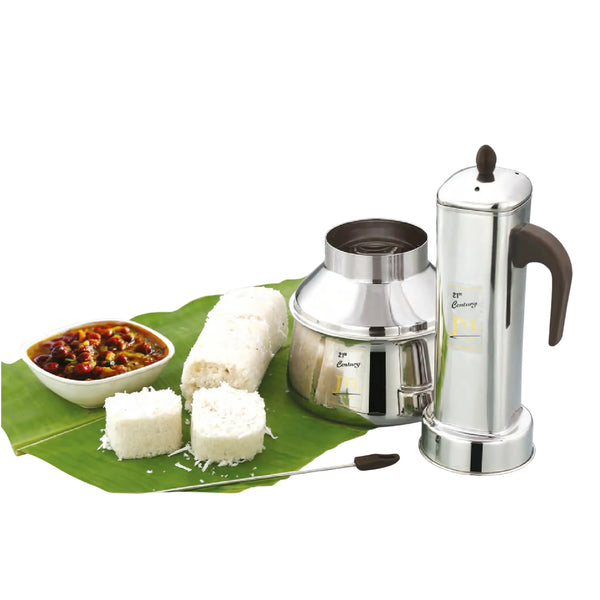
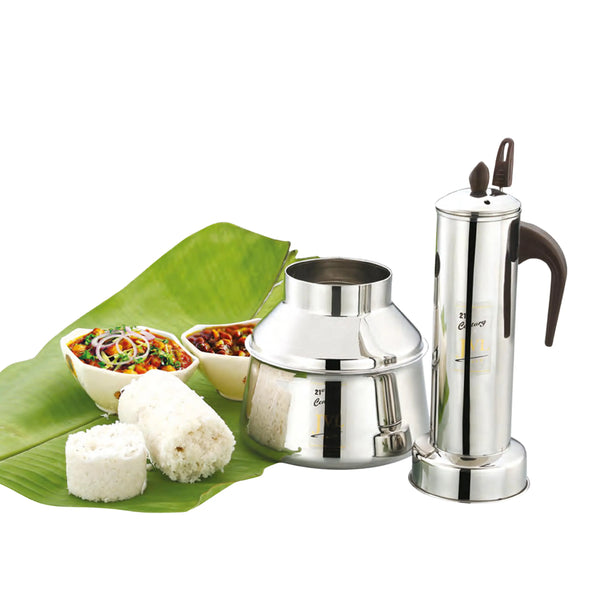
The Round puttu maker is this format built in food-grade stainless steel, designed for the household that makes puttu regularly and wants a vessel that performs authentically and lasts without replacement.
What the round puttu maker delivers in daily use:
- The classic cylindrical puttu shape that slides out cleanly onto a plate without breaking or sticking to the interior walls
- Evenly distributed steam holes at the base that allow steam to rise uniformly through the full column of layered rice flour and coconut
- Food-grade steel construction that does not react with the steam or the flour at any point in the cooking process
- A tight seal design where the cylinder meets the base vessel, directing steam upward through the flour rather than allowing it to escape at the join
- Easy disassembly after cooking — the cylinder lifts cleanly, the puttu slides out and both components wash in under a minute
For the household that eats puttu as a regular morning breakfast — two or three times a week or every single day — the round puttu maker is the vessel that makes that routine reliable, consistent and completely authentic.
The 3 Puttu Maker With Triply Base for the Family That Cooks in Volume
A single-cylinder puttu maker is the right tool for one or two people. For a family of four or more — or for a household that makes puttu for guests, for festival mornings or for a large joint family breakfast — the time spent on multiple sequential steaming cycles adds up quickly.
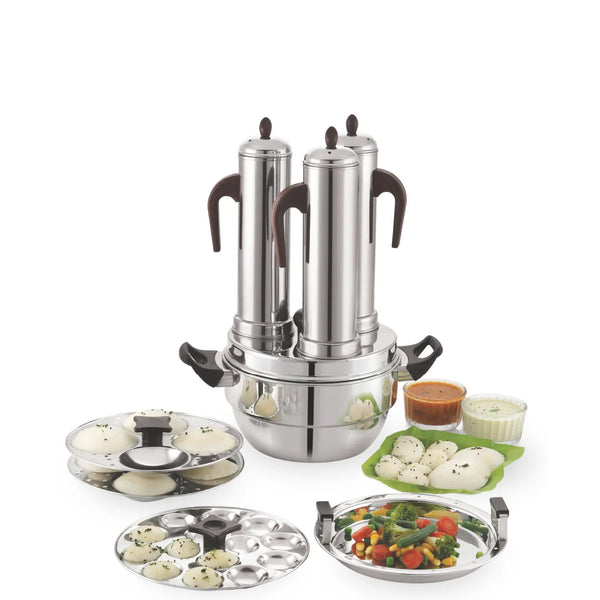
The 3 Puttu Maker with Triply Base addresses this directly. Three cylinders. One steaming cycle. A full family breakfast produced simultaneously without any relay cooking.
What the triply base changes about the cooking process:
- A triply base distributes heat evenly across the entire bottom surface rather than concentrating it at the point directly above the flame
- Even base heat produces consistent steam across all three cylinders simultaneously — each puttu cooks at the same rate with the same result
- No hot spots means no cylinder is overcooked while another finishes — all three are ready at the same moment
- The thick triply construction retains heat efficiently, which means less fuel is used to sustain the steam through the full cooking cycle
What three cylinders means for a family morning:
- A family of four is served in a single steaming cycle rather than three sequential ones
- Festival cooking or guest breakfasts that would previously require significant advance preparation become manageable in a normal morning window
- The puttu served to the first person at the table is made at the same time as the puttu served to the last
The 3 puttu maker with triply base is not a large-household luxury. It is the correct tool for any family that regularly makes puttu for more than two people and values cooking efficiency as much as authentic results.
Induction Compatibility and the Modern Kerala Kitchen
The puttu-making tradition was built around wood fires and gas stoves. The modern Indian kitchen — particularly in apartments and newer urban homes — is increasingly induction-first. A puttu steaming vessel that cannot work on an induction cooktop is, for a large and growing portion of buyers, simply not a practical option.
A stainless steel puttu steamer with a flat, induction-compatible base removes this barrier entirely.
What induction compatibility means for daily puttu making:
- The flat steel base transfers induction heat evenly across the water chamber, producing consistent steam without hot spots
- No adaptor plate is needed — the vessel sits directly on the induction surface and heats efficiently
- The same vessel works equally well on gas, ceramic and electric cooktops, making it compatible with every kitchen configuration
- Induction cooking produces a controlled, consistent heat that is actually well-suited to steam cooking — temperature can be managed precisely throughout the steaming cycle
For Keralites living in cities who have moved to induction cooking but have not wanted to give up authentic puttu, a steel puttu maker with induction-compatible construction is the product that makes both possible simultaneously.
How to Make Perfect Puttu Every Time — What the Vessel Contributes
The recipe for puttu is well known. The ratio of rice flour to water, the layer of coconut between the flour, the salt. These are fixed. What is less understood is how much of the final result is determined by the vessel rather than the recipe.
What a quality puttu cooking vessel contributes to the finished dish:
- Even steam distribution produces a puttu that is soft and cooked uniformly from the base to the top of the cylinder — no dry centre, no gummy patches
- A clean-releasing interior means the puttu slides out as a complete cylinder rather than breaking apart and losing its shape at the point of serving
- A tight base seal means all the steam energy goes into cooking the puttu rather than escaping at the join — faster cooking, more consistent results
- Correct cylinder diameter produces the classic puttu shape and portion size that the dish is meant to have
- Food-grade steel means the subtle flavour of rice flour and fresh coconut is exactly what reaches the plate — no metallic note, no residue from previous cooking sessions
There is a version of puttu that tastes like the memory of a Kerala morning. And there is a version that is close but not quite right — a little dry, a little uneven, a little different in texture from what it should be. The vessel is what separates them, not the recipe.
Choosing the Right Puttu Steamer for Your Kitchen and Your Household
The decision between puttu steamer formats comes down to two practical questions — how many people you cook for and what cooktop you use.
If you cook puttu for one or two people regularly:
The round puttu maker is the correct format. Single cylinder, authentic shape, easy daily use, fast to clean and store.
If you cook puttu for a family of four or more:
The 3 puttu maker with triply base is the correct format. Three simultaneous cylinders, even heat distribution from the triply base, one cooking cycle for a full family breakfast.
If you cook on induction:
Verify that the base of the puttu steaming vessel is flat and induction-compatible before purchasing. Both JVL formats are designed with this in mind.
What to check on any puttu steamer before buying:
- Steel grade — food-grade stainless steel specified, not just stainless steel without qualification
- Steam hole quality — clean perforations, even spacing, correct sizing for rice flour
- Seal design — the join between cylinder and base vessel should be tight enough to direct steam upward
- Interior finish — smooth, polished surface that releases cooked puttu without residue
- Base compatibility — flat base for induction, stable base for gas
Explore the full range in the Puttu Maker collection at JVL Classicware and find the format that brings authentic Kerala breakfast into your kitchen every morning.
The Morning That Deserves the Right Vessel
Puttu is not a complicated dish. But it is a dish that carries meaning — of home, of tradition, of a specific kind of morning that belongs to a specific place and culture. For the Keralite who makes it every day, it is routine. For the one who makes it once a week in a city far from Kerala, it is something closer to ritual.
Either way, the puttu steamer is the object that makes it possible. The vessel that takes rice flour and coconut and transforms them, through the simple physics of rising steam, into something that tastes exactly like it should.
A food-grade stainless steel puttu steamer, built with the correct steam hole design, the right seal and the material quality to last through years of daily use, is the vessel that does this faithfully every single time. Not approximately. Not most of the time. Every time.
That is what the right puttu steamer delivers. And once you have experienced it, the difference is impossible to settle for less than.